

Introduction
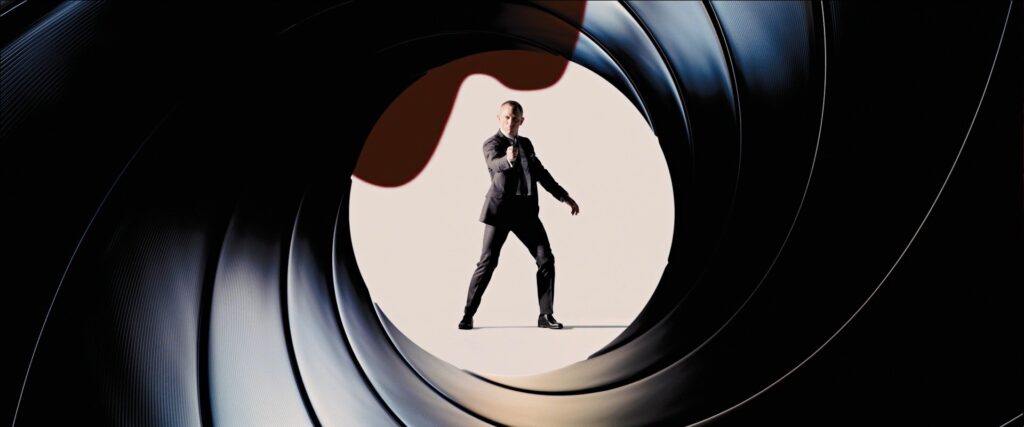
The James Bond franchise is more than a long-running series of spy films—it is a living cinematic institution that has evolved alongside modern history, technology, and global culture. First appearing on screen in 1962, Bond emerged at the height of the Cold War as a symbol of Western cool, confidence, and calculated danger. From the opening gun-barrel sequence to the final quip after a daring escape, the franchise established a ritualistic rhythm that audiences instantly recognized and eagerly returned to. Few characters in film history have maintained such immediate recognizability while continuously reinventing themselves for new generations.
At its core, James Bond represents the fantasy of absolute competence in an uncertain world. He is a government agent tasked with confronting threats too large, secretive, or politically volatile for conventional solutions. Whether dismantling criminal syndicates, rogue intelligence networks, or megalomaniacal villains bent on global domination, Bond operates in moral gray zones where charm and violence coexist. The films reflect the anxieties of their times—nuclear escalation, energy crises, media manipulation, cyber warfare, terrorism—while allowing audiences to experience those fears through spectacle, wit, and escapism rather than despair.
What truly sets the franchise apart is its ability to adapt without losing its identity. Each era reshapes Bond to match contemporary tastes, shifting from the cool menace of the 1960s, to the playful excess of the 1970s, to the grittier realism of the late 1980s, and eventually to the emotionally complex, character-driven storytelling of the 21st century. These transformations are not rejections of the past but recalibrations, preserving signature elements—luxury cars, exotic locations, ingenious gadgets, and iconic theme songs—while redefining what Bond means in a changing world.
The franchise also functions as a mirror of cinematic trends. James Bond films have consistently pushed technical boundaries, pioneering large-scale action choreography, location shooting across the globe, and practical stunt work that often defies belief. Long before shared universes became fashionable, Bond mastered continuity through tone, tradition, and character rather than rigid narrative threads. The result is a series that can be watched as standalone adventures or as a sweeping chronicle of evolving masculinity, geopolitics, and blockbuster filmmaking.
Ultimately, James Bond endures because it balances permanence and risk. It honors its mythology while daring to challenge it, occasionally questioning the cost of heroism, loyalty, and violence beneath the tuxedo. Across decades of change, Bond remains a cultural constant—not because he stays the same, but because the franchise understands when to polish the legend and when to break it apart. That delicate balance is why 007 continues to matter, long after the martinis have been poured and the credits have rolled.
Film Summary
Dr. No (1962) — Sean Connery – Dr. No launches the legend with sleek confidence, establishing Bond’s methods and manners as he dismantles a Caribbean nuclear plot. The film’s economy and menace make it a template that still holds up.
- Leading Lady: Honey Ryder (played by Ursula Andress)
- Villain: Dr. Julius No (played by Joseph Wiseman)
- Theme Song: James Bond Theme (composer John Barry)
- Budget: $1.1 Million
From Russia with Love (1963) — Sean Connery – From Russia with Love deepens the intrigue, pitting Bond against a cunning chessboard of deception. Its grounded tension and espionage craft are among the series’ finest.
- Leading Lady: Daniela Bianchi (played by Tatiana Romanova)
- Villain: Rosa Klebb (played by Lotte Lenya)
- Theme Song: From Russia with Love (composer Lionel Bart)
- Budget: $2.0 Million
Goldfinger (1964) — Sean Connery – Goldfinger explodes the formula into pop-culture immortality, marrying iconic villainy with unforgettable set pieces. It defines Bond’s swagger and scale.
- Leading Lady: Pussy Galore (played by Honor Blackman)
- Villain: Auric Goldfinger (played by Gert Frobe)
- Theme Song: Goldfinger (composer John Barry)
- Budget: $3.0 Million
Thunderball (1965) — Sean Connery – Thunderball raises the stakes underwater, delivering spectacle and espionage in equal measure as Bond races to stop nuclear blackmail.
- Leading Lady: Domino Derval (played by Claudine Auger)
- Villain: Emilio Largo (played by Adolfo Celi)
- Theme Song: Thunderball (composer John Barry & Don Black)
- Budget: $9.0 Million
You Only Live Twice (1967) — Sean Connery – You Only Live Twice embraces globetrotting fantasy, sending Bond to Japan with ninja training and volcanic lairs that cement the franchise’s larger-than-life ambitions.
- Leading Lady: Kissy Suzuki (played by Mie Hama)
- Villain: Ernst Stavro Blofeld (played by Donald Pleasence)
- Theme Song: You Only Live Twice (composer John Barry & Leslie Bricusse)
- Budget: $10.3 Million
On Her Majesty’s Secret Service (1969) — George Lazenby – On Her Majesty’s Secret Service surprises with emotional depth, revealing Bond’s vulnerability through romance and loss, and earning retroactive acclaim for its daring tone.
- Leading Lady: Tracy di Vicenzo (played by Diana Rigg)
- Villain: Ernst Stavro Blofeld (played by Telly Savalas)
- Theme Song: Instrumental Theme (composer John Barry)
- Budget: $7.0 Million
Diamonds Are Forever (1971) — Sean Connery -Diamonds Are Forever returns to campy charm, closing Connery’s era with wit and a knowing grin.
- Leading Lady: Tiffany Case (played by Jill St. John)
- Villain: Ernst Stavro Blofeld (played by Charles Gray)
- Theme Song: Diamonds Are Forever (composer John Barry & Don Black)
- Budget: $7.1 Million
Live and Let Die (1973) — Roger Moore – Live and Let Die refreshes Bond with reggae rhythms and a darker mysticism, introducing Roger Moore’s lighter touch.
- Leading Lady: Solitaire (played by Jane Seymour)
- Villain: Dr. Kananga / Mr. Big (played by Yaphet Kotto)
- Theme Song: Live and Let Die (composer Paul McCartney & Linda McCartney)
- Budget: $7.0 Million
The Man with the Golden Gun (1974) — Roger Moore – The Man with the Golden Gun centers on a duel of assassins, pairing humor with menace in a lean chase across Asia.
- Leading Lady: Mary Goodnight (played by Britt Ekland)
- Villain: Francisco Scaramanga (played by Christopher Lee)
- Theme Song: The Man with the Golden Gun (composer John Barry & Don Black)
- Budget: $7.0 Million
The Spy Who Loved Me (1977) — Roger Moore – The Spy Who Loved Me perfects Moore’s blend of spectacle and romance, delivering one of the most beloved entries with audacious action.
- Leading Lady: Anya Amasova (played by Barbara Bach)
- Villain: Karl Stromberg (played by Curd Jurgens)
- Theme Song: No Body Does It Better (composer Marvin Hamlisch & Carole Bayer Sager)
- Budget: $14.0 Million
Moonraker (1979) — Roger Moore – Moonraker reaches for the stars, literally, indulging in space-age excess that epitomizes late-70s blockbuster bravado.
- Leading Lady: Dr. Holly Goodhead (played by Lois Chiles)
- Villain: Hugo Drax (played by Michael Lonsdale)
- Theme Song: Moonraker (composer John Barry & Hal David)
- Budget: $34.0 Million
For Your Eyes Only (1981) — Roger Moore – For Your Eyes Only reins things back to earth, favoring grounded espionage and character stakes over extravagance.
- Leading Lady: Melina Havelock (played by Carole Bouquet)
- Villain: Aristotle Kristatos (played by Julian Glover)
- Theme Song: For Your Eyes Only (composer Bill Conti & Mick Leeson)
- Budget: $28.0 Million
Octopussy (1983) — Roger Moore – Octopussy mixes Cold War tension with playful flair, showcasing Moore’s seasoned charm.
- Leading Lady: Octopussy (played by Maud Adams)
- Villain: Kamal Khan (played by Louis Jourdan)
- Theme Song: All Time High (Composer John Barry & Tim Rice)
- Budget: $27.5 Million
A View to a Kill (1985) — Roger Moore – A View to a Kill closes the Moore chapter with high-concept villainy and a memorable musical pulse.
- Leading Lady: Stacey Sutton (played by Tanya Roberts)
- Villain: Max Zorin (played by Christopher Walken)
- Theme Song: A View to a Kill (Composer Duran Duran & John Barry)
- Budget: $30.0 Million
The Living Daylights (1987) — Timothy Dalton – The Living Daylights introduces a tougher Bond, emphasizing realism and political complexity.
- Leading Lady: Kara Milovy (played by Maryam d’Abo)
- Villain: General Georgi Koskov (played by Jeroen Krabbe)
- Theme Song: The Living Daylights (composer John Barry)
- Budget: $40.0 Million
Licence to Kill (1989) — Timothy Dalton – Licence to Kill goes rogue, offering a revenge-driven narrative that foreshadows the franchise’s later grit.
- Leading Lady: Pam Bouvier (played by Carey Lowell)
- Villain: Franz Sanchez (played by Robert Davi)
- Theme Song: License to Kill (composer John Barry & Don Black)
- Budget: $42.0 Million
Golden Eye (1995) — Pierce Brosnan – Golden Eye revitalizes Bond for the post-Cold War world, pairing modern action with a smart reassessment of 007’s relevance.
- Leading Lady: Natalya Simonova (played by Izabella Scorupco)
- Villain: Alec Trevelyan (played by Sean Bean)
- Theme Song: Golden Eye (composer Bono & The Edge)
- Budget: $60.0 Million
Tomorrow Never Dies (1997) — Pierce Brosnan – Tomorrow Never Dies skewers media power through relentless pacing and set pieces.
- Leading Lady: Wai Lin (played by Michelle Yeoh)
- Villain: Elliot Carver (played by Jonathan Pryce)
- Theme Song: Tomorrow Never Dies (composer David Arnold & Don Black)
- Budget: $110.0 Million
The World Is Not Enough (1999) — Pierce Brosnan – The World Is Not Enough explores emotional connections and betrayal, adding nuance to the spectacle.
- Leading Lady: Christmas Jones (played by Denise Richards)
- Villain: Renard (played by Robert Carlyle)
- Theme Song: The World Is Not Enough (composer David Arnold)
- Budget: $135.0 Million
Die Another Day (2002) — Pierce Brosnan – Die Another Day celebrates excess with ice palaces and invisibility, a maximalist farewell to Brosnan’s run.
- Leading Lady: Jinx Johnson (played by Halle Berry)
- Villain: Gustav Graves (played by Toby Stephens)
- Theme Song: Die Another Day (composer Madonna & Mirwais Ahmadzai)
- Budget: $142.0 Million
Casino Royale (2006) — Daniel Craig – Casino Royale reboots Bond with raw intensity, charting the making of 007 through love, loss, and high-stakes poker.
- Leading Lady: Vesper Lynd (played by Eva Green)
- Villain: Le Chiffre (played by Mads Mikkelsen)
- Theme Song: You Know My Name (composer Chris Cornell & David Arnold)
- Budget: $150.0 Million
Quantum of Solace (2008) — Daniel Craig – Quantum of Solace continues the trauma, delivering a kinetic, revenge-fueled chapter.
- Leading Lady: Camille Montes (played by Olga Kurylenko)
- Villain: Dominic Greene (played by Mathieu Amalric)
- Theme Song: Another Way to Die (composer Jack White)
- Budget: $200.0 Million
Skyfall (2012) — Daniel Craig – Skyfall meditates on legacy and loyalty, blending blockbuster thrills with character study and becoming a modern classic.
- Leading Lady: Severine (played by Berenice Marlohe)
- Villain: Raoul Silva (played by Javier Bardem)
- Theme Song: Skyfall (composer Adele Adkins & Paul Epworth)
- Budget: $200.0 Million
Spectre (2015) — Daniel Craig – Spectre attempts to unify past threads, leaning into mythology while expanding Bond’s emotional arc.
- Leading Lady: Madeleine Swann (played by Lea Seydoux)
- Villain: Ernst Stavro Blofeld (played by Christoph Waltz)
- Theme Song: Writing’s on the Wall (composer Sam Smith & Jimmy Napes)
- Budget: $245.0 Million
No Time to Die (2021) — Daniel Craig – No Time to Die delivers a definitive, daring finale, embracing consequence and closure in a way the franchise had never attempted before.
- Leading Lady: Madeleine Swann (played by Lea Seydoux)
- Villain: Lyutsifer Safin (played by Rami Malek)
- Theme Song: No Time to Die (composer Billie Eilish & Finneas O’Connell)
- Budget: $250.0 – $301.0 Million
Film-by-Film Synopsys
Dr. No (1962) – Sean Connery
Dr. No stands as one of the most important films in cinema history, not because of overwhelming spectacle, but because it quietly launched a legend. Released in 1962, the film introduced audiences to James Bond—Agent 007 of MI6—at a time when spy thrillers were largely grounded and restrained. What Dr. No offered instead was a bold new archetype: a secret agent who blended lethal competence with effortless charm, dry humor, and an unmistakable sense of style. From its opening moments, the film establishes a confident tone that suggests this world is dangerous, glamorous, and unlike anything audiences had seen before.
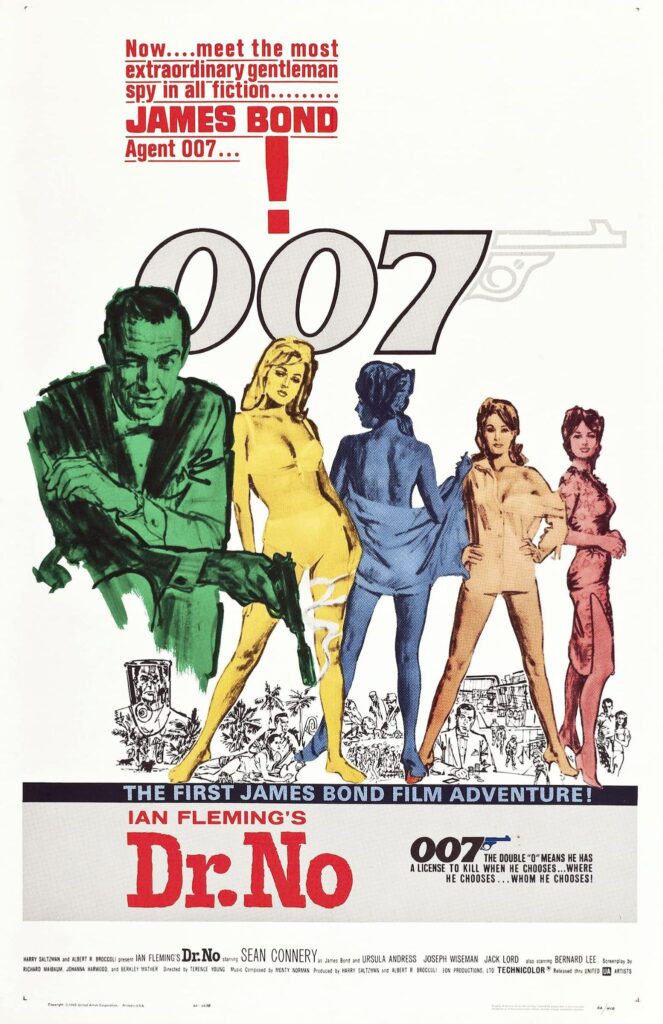
The story begins in Jamaica, where the mysterious disappearance of a British intelligence operative draws Bond into an investigation that quickly spirals beyond a routine assignment. As Bond follows a trail of assassinations, sabotage, and cryptic clues, he uncovers a shadowy operation centered on Crab Key, a forbidden island owned by the enigmatic Dr. Julius No. The narrative unfolds with deliberate pacing, allowing tension to build through dialogue, atmosphere, and suspicion rather than constant action. This slow-burn approach gives the film an almost noir-like quality, grounding the espionage in realism while hinting at something far more sinister beneath the surface.
Sean Connery’s debut as Bond is the film’s defining achievement. His portrayal is cool, dangerous, and self-assured, immediately cementing the character’s identity. Connery’s Bond is not flashy or exaggerated; instead, he commands attention through posture, voice, and restraint. The now-iconic introduction—Bond calmly gambling in a casino and delivering the line “Bond, James Bond”—instantly crystallizes the character and became one of the most famous moments in film history. Connery balances menace and charm so naturally that it feels as though the role was created specifically for him.
One of the film’s most enduring cultural moments arrives with the introduction of Honey Ryder, portrayed by Ursula Andress. Emerging from the sea in a white bikini, Honey Ryder became an instant symbol of cinematic glamour and remains one of the most iconic images in film history. Yet beyond the visual impact, her character also represents a key evolution in the franchise: a capable, independent woman who is more than just a passive companion. Her presence adds warmth and humanity to the story while reinforcing the exotic, adventurous tone the franchise would embrace for decades.
Dr. No himself, portrayed by Joseph Wiseman, is a restrained but effective villain. Rather than relying on bombastic speeches or constant screen time, the character exudes menace through control, intellect, and isolation. His sterile lair, mechanical hands, and obsession with power foreshadow the extravagant villain archetypes that would later define the series. Importantly, Dr. No introduces the idea of a Bond villain as a figure who operates above governments, pursuing personal ambition on a global scale—an idea that would become central to the franchise’s identity.
In its final act, Dr. No delivers a satisfying confrontation that blends espionage, science fiction, and physical danger without losing its grounded tone. The climax emphasizes Bond’s ingenuity and resilience rather than brute force, reinforcing the character’s appeal as a thinking man’s action hero. The film closes with a sense of victory and confidence, leaving audiences eager for more adventures from this newly introduced agent.
Viewed today, Dr. No may seem modest compared to later Bond epics, but its importance cannot be overstated. It established the DNA of the franchise—exotic locations, memorable villains, seductive intrigue, and a charismatic hero—while proving that a spy film could be stylish, thrilling, and commercially successful. More than sixty years later, Dr. No remains a foundational chapter in the James Bond legacy, not just as the beginning of a series, but as the birth of one of cinema’s most enduring icons.
Did You Know:
- Dr. No was produced on a surprisingly modest budget, making its global success even more remarkable and proving that style and character could outweigh spectacle.
- Sean Connery was not the studio’s first choice for James Bond, but his raw confidence and physical presence ultimately defined the role for generations.
- The famous line “Bond, James Bond” was not highlighted as iconic during production—it became legendary only after audiences responded so strongly to Connery’s delivery.
- Ursula Andress’s white bikini was so influential that it is often cited as one of the most famous costumes in film history and helped redefine cinematic glamour.
- Joseph Wiseman’s Dr. No appears on screen far less than many later Bond villains, yet his calm, controlled demeanor made him deeply unsettling.
- The film was shot extensively in Jamaica, which gave Dr. No a tropical authenticity that stood apart from studio-bound thrillers of the era.
- Dr. No’s mechanical hands were created as a visual symbol of cold intellect overpowering humanity, setting a template for the franchise’s fascination with technology and power.
- Dr. No introduced the now-classic Bond gun-barrel opening, establishing a visual ritual that would become synonymous with the series.
- Despite its later reputation, the film initially faced skepticism from critics who were unsure if audiences would embrace such a stylish, morally ambiguous hero.
- Dr. No was the only James Bond film to premiere in the United Kingdom without a royal premiere, as the franchise had not yet proven its cultural impact.
From Russia with Love (1963) – Sean Connery
From Russia with Love is widely regarded as one of the most tightly constructed and intelligently plotted entries in the entire James Bond franchise. Released just one year after Dr. No, the film builds on the success of Bond’s cinematic debut by deepening the espionage, sharpening the danger, and grounding the story in a more realistic and psychologically tense world. Rather than relying on spectacle alone, From Russia with Love leans heavily into Cold War paranoia, deception, and manipulation, creating a spy thriller that feels methodical, sinister, and remarkably mature for its era.
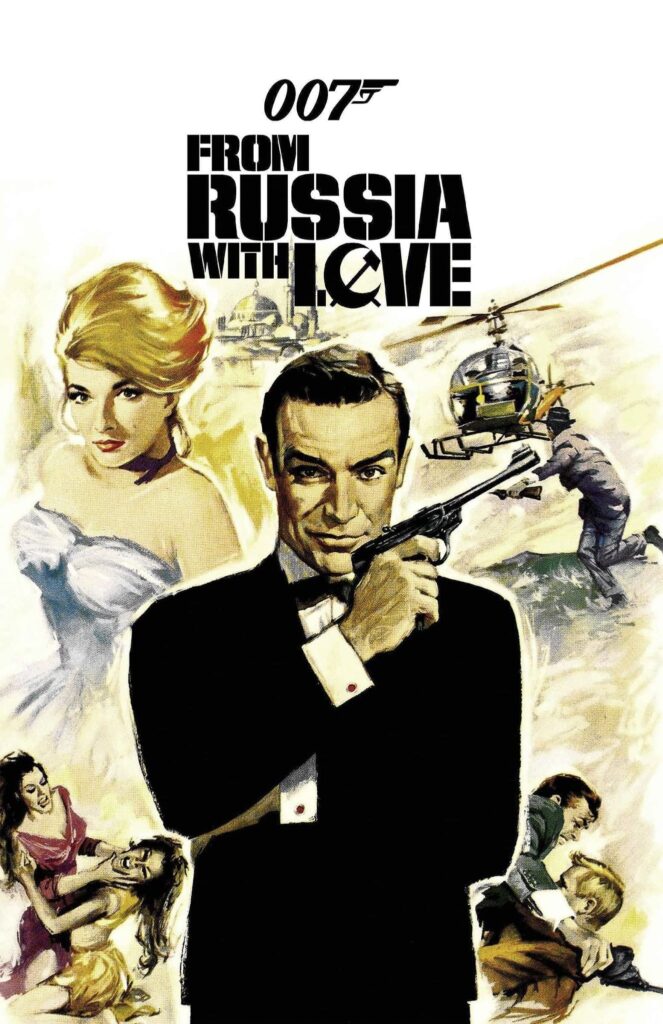
The plot centers on a carefully orchestrated trap set by SPECTRE, the shadowy criminal organization seeking revenge for Dr. No’s defeat. Using the geopolitical tensions between East and West as cover, SPECTRE lures Bond into a mission involving a beautiful Soviet cipher clerk, Tatiana Romanova, and a coveted decoding device known as the Lektor. What appears at first to be a straightforward defection mission gradually reveals itself as a deadly chess match, with Bond unknowingly positioned as the final piece. This layered narrative gives the film a constant undercurrent of danger, as the audience is aware of the conspiracy long before Bond himself is.
Sean Connery’s second performance as James Bond shows a noticeable evolution in the character. While still confident and charismatic, this Bond feels more alert and vulnerable, forced to rely on instinct and intelligence rather than bravado. Connery portrays Bond as a professional operative navigating a world where enemies hide behind bureaucracy, loyalty is uncertain, and even allies may be compromised. The film allows Bond to be hunted as much as he hunts, which heightens the tension and makes his eventual triumphs feel earned rather than inevitable.
The villains of From Russia with Love are among the most memorable in the franchise. Rosa Klebb, portrayed with chilling severity by Lotte Lenya, brings an almost bureaucratic cruelty to the role, embodying the quiet menace of institutional power. Her enforcer, Red Grant—played by Robert Shaw—is one of Bond’s most physically intimidating adversaries. Grant is not flashy or theatrical; he is relentless, silent, and methodical, culminating in the now-iconic train fight sequence. This brutal, claustrophobic confrontation strips away gadgets and glamour, leaving Bond to survive through sheer will and cunning.
Tatiana Romanova, portrayed by Daniela Bianchi, adds emotional complexity to the story. Unlike many early Bond heroines, Tatiana is not simply a conquest or accomplice but a manipulated pawn caught between forces far beyond her control. Her gradual realization of the truth mirrors the audience’s growing awareness of SPECTRE’s reach, and her vulnerability adds human stakes to an otherwise calculated operation. The romance between Bond and Tatiana feels less playful and more consequential, reinforcing the film’s grounded tone.
Visually, the film excels through its use of real-world locations, particularly Istanbul, whose narrow streets, bazaars, and ancient architecture lend the story an authentic sense of place. The blending of exotic settings with realistic espionage techniques—surveillance, coded messages, dead drops—gives the film a documentary-like credibility that distinguishes it from later, more extravagant Bond adventures. John Barry’s score further enhances the mood, weaving suspense and elegance into every scene without overwhelming the narrative.
In the final act, From Russia with Love delivers a measured but deeply satisfying conclusion. Bond escapes not through overwhelming force, but through awareness, adaptability, and experience—traits that define the character at his best. The film ends with a sense of survival rather than triumph, reinforcing the idea that victory in espionage is often narrow and temporary.
Today, From Russia with Love is frequently cited by critics and fans as the quintessential Bond film. Its disciplined storytelling, iconic villains, and grounded realism create a timeless spy thriller that transcends the franchise’s more flamboyant tendencies. More than just a sequel, it solidified James Bond as a cinematic force and proved that 007 could thrive not only on spectacle, but on intelligence, tension, and craft.
Did You Know:
- From Russia with Love was the only James Bond film named in former U.S. President John F. Kennedy’s list of favorite movies, which significantly boosted the franchise’s popularity in America.
- The film marks the first full appearance of SPECTRE as an organization, establishing the shadowy criminal network that would loom over multiple Bond films.
- Robert Shaw’s character, Red Grant, was deliberately written as a dark mirror of Bond—a trained killer with similar skills but no moral restraint.
- The brutal train fight scene between Bond and Red Grant is often cited as one of the most realistic hand-to-hand combat sequences in the entire franchise.
- Lotte Lenya’s Rosa Klebb was originally doubted by producers as a credible villain, but her cold, authoritarian performance became one of the series’ most unsettling portrayals.
- The deadly shoe blade weapon used by Rosa Klebb became one of the franchise’s earliest examples of concealed, character-specific gadgetry.
- Much of the Istanbul footage was shot on location, helping give the film a level of authenticity rarely seen in early 1960s spy movies.
- Sean Connery was reportedly paid significantly more for this film than Dr. No, reflecting the immediate success of his debut as Bond.
- Unlike many later Bond films, the climax relies more on suspense and survival than large-scale explosions, reinforcing the film’s grounded tone.
Goldfinger (1964) – Sean Connery
Goldfinger is often regarded as the defining entry in the James Bond franchise—the film that perfected the formula and transformed 007 from a successful character into a full-blown cultural phenomenon. Arriving as the third Bond film, Goldfinger expanded the scale, sharpened the humor, and leaned boldly into spectacle, setting the template that would guide the series for decades. Nearly every iconic Bond trope—from extravagant villains to ingenious gadgets and lavish set pieces—finds its most influential early expression here.
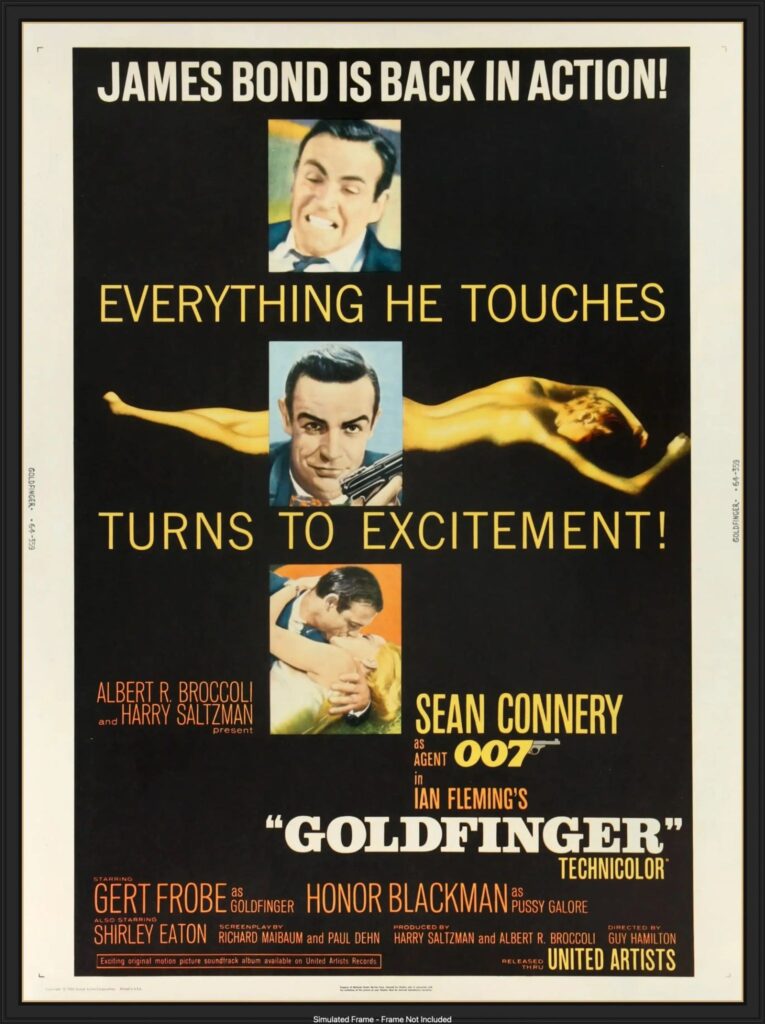
The story opens with Bond uncovering a gold-smuggling operation linked to the enigmatic Auric Goldfinger, a man whose obsession with wealth borders on the pathological. What begins as a seemingly contained investigation soon escalates into a threat of global proportions when Bond learns that Goldfinger is planning an audacious assault on the United States gold reserve at Fort Knox. The plot balances espionage with high-concept ambition, blending real-world locations with an almost comic-book sense of villainy that feels both outrageous and plausible within the Bond universe.
Sean Connery’s performance is fully assured, presenting a Bond who is confident, witty, and unmistakably dominant in every room he enters. Connery’s portrayal here crystallizes the character’s persona—cool under pressure, dangerous when crossed, and effortlessly charming even in captivity. Bond is captured for a significant portion of the film, but rather than diminishing his agency, this restraint heightens tension and allows the character’s intelligence and psychological resilience to take center stage.
Auric Goldfinger, portrayed memorably by Gert Fröbe, is one of the most iconic villains in cinema history. His calm demeanor, meticulous planning, and singular obsession with gold make him both fascinating and terrifying. Unlike villains driven by ideology or revenge, Goldfinger’s motivation is pure greed elevated to megalomania. His henchman Oddjob, deadly silent and armed with a razor-edged bowler hat, adds a physical menace that contrasts perfectly with Goldfinger’s calculated control, creating one of the franchise’s most unforgettable villain duos.
The film also introduces Bond’s relationship with technology in a more explicit and playful way. Q’s briefing scene delivers the legendary Aston Martin DB5, complete with ejector seat, machine guns, and defensive countermeasures. This moment cemented gadgets as a core element of the franchise and transformed Bond’s car into an extension of his identity. The DB5 would go on to become one of the most recognizable vehicles in film history, synonymous with sophistication and danger.
Visually, Goldfinger is rich with bold imagery that has become permanently embedded in pop culture. The shocking death of Jill Masterson, painted entirely in gold, remains one of the most striking and controversial moments in the series. Shirley Eaton’s performance as the ill-fated Bond girl is brief but unforgettable, reinforcing the idea that beauty and danger are inseparable in Bond’s world. Meanwhile, Honor Blackman’s Pussy Galore stands out as one of the franchise’s most assertive and capable female characters, challenging Bond in ways few others had before.
The film’s pacing is confident and deliberate, allowing suspense to build through dialogue, character interaction, and looming threat rather than constant action. John Barry’s brassy, commanding score—paired with Shirley Bassey’s powerhouse title song—elevates the film’s sense of grandeur and importance, making it feel larger than life without losing narrative focus.
In its climactic final act, Goldfinger delivers a thrilling race against time inside Fort Knox, blending espionage, military response, and last-minute heroics into a conclusion that feels both epic and satisfying. The resolution reinforces Bond’s role as a guardian of global stability while acknowledging the fragile margins between disaster and survival.
More than sixty years after its release, Goldfinger remains a benchmark not only for James Bond films but for blockbuster cinema as a whole. It perfected the balance between realism and fantasy, danger and glamour, intelligence and spectacle. For many fans, Goldfinger is not just a great Bond movie—it is the Bond movie, a definitive expression of everything that makes 007 endure.
Did You Know:
- Goldfinger was the first Bond film to become a massive global box-office phenomenon, firmly establishing 007 as a pop-culture icon rather than a niche spy character.
- The iconic Aston Martin DB5 made its debut in this film, and its popularity was so overwhelming that it became permanently associated with James Bond.
- Shirley Eaton, who played Jill Masterson, was not actually painted head-to-toe in gold for safety reasons; only portions of her body were painted at a time to prevent health risks.
- The famous laser table scene was so influential that it permanently changed expectations for Bond villain theatrics, even though lasers were not yet common technology in 1964.
- Gert Fröbe’s voice was dubbed for much of the film, as his German accent was considered too strong for English-speaking audiences.
- Oddjob’s razor-rimmed bowler hat became one of the most recognizable henchman weapons in movie history, inspiring countless parodies.
- Shirley Bassey’s powerful title song “Goldfinger” set the standard for future Bond themes with its bold brass arrangement and dramatic vocals.
- Ian Fleming himself reportedly considered Goldfinger one of the strongest cinematic adaptations of his Bond novels.
- The Fort Knox interior scenes were not filmed inside the real vault, as filming permission was denied; detailed sets were built instead.
- Goldfinger was the first Bond film to win an Academy Award, earning an Oscar for Best Sound Editing.
Thunderball (1965) – Sean Connery
Thunderball marked a dramatic escalation in scale and spectacle for the James Bond franchise, solidifying 007 as a global blockbuster phenomenon. As the fourth Bond film and the last of Sean Connery’s initial run to fully embrace the classic formula, Thunderball pushed the series into grander territory with lavish locations, underwater action, and stakes that threatened the entire world. It is a film defined by ambition—technically, narratively, and visually—and it reflects a franchise growing rapidly in confidence and popularity.
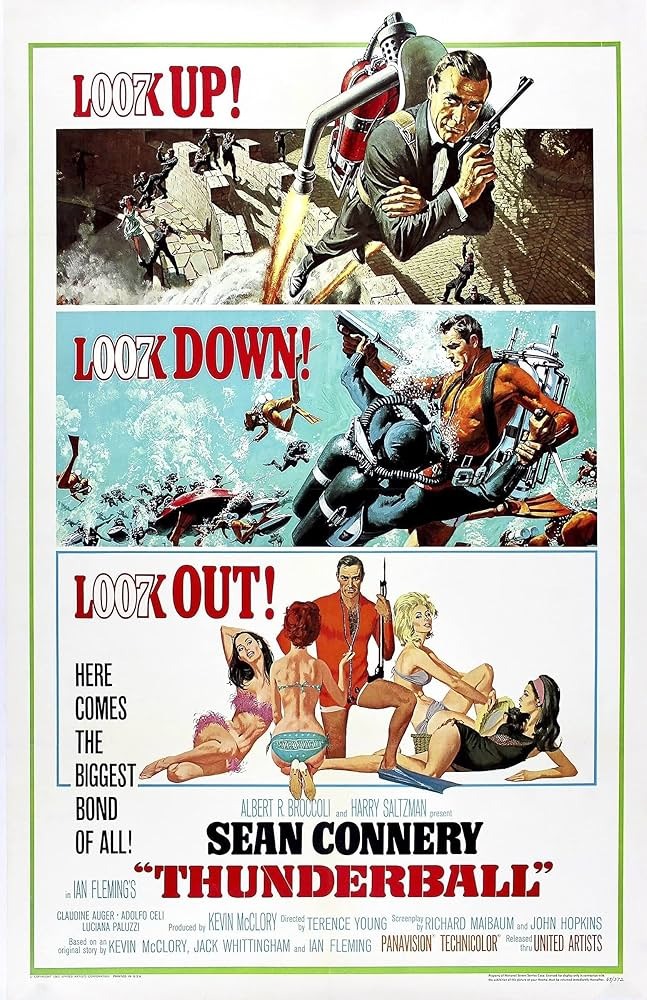
The story opens with SPECTRE executing one of its boldest schemes yet: the theft of two NATO nuclear warheads, which are then used to blackmail the world’s major powers. James Bond is dispatched to the Bahamas, where clues suggest that the operation is being orchestrated by the suave and sinister Emilio Largo, a high-ranking SPECTRE operative. What follows is a classic Bond investigation that blends luxury and danger, as Bond navigates casinos, oceanfront estates, and coral reefs while piecing together the scope of the threat.
Sean Connery’s Bond in Thunderball is fully comfortable in his role, exuding authority and confidence at every turn. This version of Bond is less about proving himself and more about asserting dominance—both intellectually and physically—over his enemies. Connery plays Bond as a seasoned professional, capable of charm and violence in equal measure, and the film allows him to command the screen with minimal exposition. His interactions feel effortless, reinforcing the idea that Bond has become the gold standard for cinematic spies.
Emilio Largo, portrayed by Adolfo Celi, stands out as one of the franchise’s most polished and calculating villains. Unlike more theatrical antagonists, Largo operates with calm precision, letting his wealth, organization, and strategic patience do the talking. His eyepatch, tailored suits, and luxury yacht give him a distinctive visual presence, while his willingness to kill subordinates without hesitation underscores SPECTRE’s ruthless efficiency. Largo’s menace lies not in grand speeches, but in his quiet certainty that his plan cannot fail.
One of Thunderball’s defining features is its extensive use of underwater action sequences—an ambitious and technically groundbreaking choice at the time. These scenes, culminating in a massive underwater battle between Bond, Largo’s forces, and NATO divers, were unlike anything audiences had seen before. Though deliberately paced, they emphasized realism, scale, and innovation, showcasing a new dimension of action filmmaking and reinforcing the film’s sense of global consequence.
The Bond girls of Thunderball also play a more integral role in the narrative. Claudine Auger’s Domino Derval is emotionally central to the story, torn between loyalty to Largo and her growing awareness of his cruelty. Her arc adds genuine pathos to the film, transforming her from a glamorous companion into a catalyst for the villain’s downfall. The Bahamas setting, combined with underwater photography and sun-soaked cinematography, gives the film an unmistakable sense of exotic allure.
Musically, John Barry’s score reinforces the film’s epic tone, while the title song “Thunderball” announces the film’s scale with bold brass and dramatic vocals. Everything about the production—from costumes to sets to pacing—signals that James Bond is no longer just a popular series, but a dominant cinematic force capable of commanding massive audiences worldwide.
In its final act, Thunderball delivers a tense and visually rich confrontation that brings together espionage, military intervention, and personal revenge. Bond’s victory feels hard-earned, achieved through persistence, intelligence, and the willingness to exploit his enemies’ weaknesses rather than relying solely on brute force.
Today, Thunderball is remembered as a cornerstone of the classic Bond era—a film that defined the franchise’s love of luxury, global stakes, and technological bravado. While later entries would refine and sometimes parody its excesses, Thunderball remains a bold statement of intent: James Bond had arrived as cinema’s premier action hero, and the world was watching.
Did You Know:
- Thunderball was the most expensive Bond film ever made at the time, reflecting its massive underwater sequences and international production scale.
- The film features more underwater footage than any other Bond movie, with some sequences taking weeks to film due to technical and safety challenges.
- Sean Connery reportedly grew increasingly frustrated with the role during production, contributing to his decision to step away from Bond after this era.
- The underwater breathing apparatuses used by Bond were real prototypes, not props, making filming more difficult but adding realism.
- Adolfo Celi’s voice as Emilio Largo was dubbed in post-production, as his accent was considered too heavy for audiences.
- The climactic underwater battle involved dozens of professional divers, making it one of the largest underwater action scenes ever filmed at the time.
- The film’s plot originated from an unproduced James Bond screenplay, which was later adapted into both the novel and the movie.
- Thunderball was the first Bond film to be released simultaneously worldwide, demonstrating the franchise’s growing global dominance.
- The luxurious yacht Disco Volante became one of the most iconic villain vehicles in the entire series.
- Thunderball went on to become the highest-grossing Bond film of the 1960s, cementing 007’s blockbuster status.
You Only Live Twice (1967) – Sean Connery
You Only Live Twice represents a bold turning point in the James Bond franchise, fully embracing spectacle, scale, and cinematic fantasy. As the fifth official Bond film and Sean Connery’s penultimate appearance in the role during his original run, the movie pushes the series into operatic territory. Released at the height of the Cold War and the Space Race, You Only Live Twice reflects a world gripped by geopolitical tension and technological competition, transforming those anxieties into an extravagant, globe-spanning adventure.
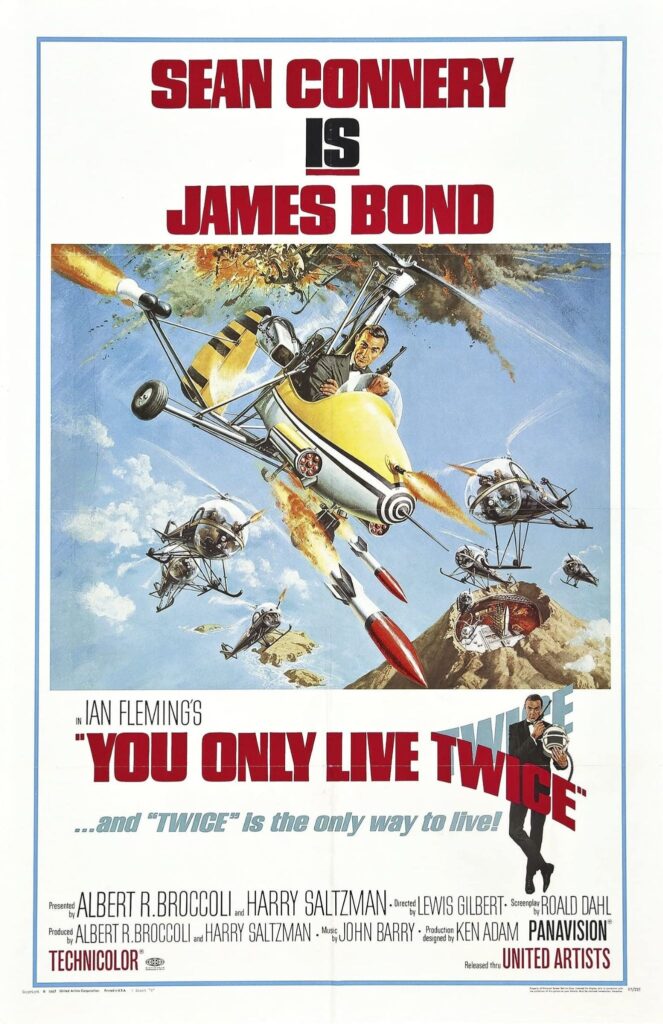
The story begins with a series of mysterious spacecraft hijackings, threatening to spark a catastrophic conflict between the world’s superpowers. When both the United States and the Soviet Union suspect each other of sabotage, James Bond is sent to Japan to uncover the truth behind the disappearances. To infiltrate enemy territory, Bond is declared dead and must operate entirely off the grid, setting the stage for a mission where identity, deception, and rebirth become central themes. This narrative device reinforces the idea of Bond as a mythic figure—someone who can vanish and re-emerge when the world needs him most.
Sean Connery’s performance in You Only Live Twice reflects a Bond who is more assured and almost legendary in stature. While less grounded than earlier entries, Connery’s Bond here feels like an unstoppable force, moving confidently through danger with a sense of inevitability. The film leans heavily into visual storytelling and grand set pieces, allowing Connery to play the role with minimal introspection but maximum presence. This version of Bond feels less like a man and more like an icon, perfectly suited to the film’s heightened tone.
The true star of the film, however, is its villain. Ernst Stavro Blofeld finally steps fully into the spotlight, portrayed by Donald Pleasence with chilling restraint. Blofeld’s calm voice, scarred visage, and emotionless authority redefine what a Bond villain could be. Operating from an immense volcano lair hidden in the Japanese countryside, Blofeld orchestrates global chaos with surgical precision, embodying pure, detached evil. His lair—complete with retractable roof, control room, and armies of henchmen—became one of the most iconic villain headquarters in cinema history and cemented the franchise’s love for larger-than-life antagonists.
The Japanese setting gives You Only Live Twice a distinct visual identity. From bustling cities to remote fishing villages, the film immerses itself in local culture while filtering it through the lens of 1960s Western fascination with the East. Bond’s temporary transformation—marrying into a Japanese family and adopting a new identity—adds a surreal, almost dreamlike quality to the middle act of the film. While dated in places, these sequences underscore the film’s themes of reinvention and survival.
Action in You Only Live Twice is expansive and inventive. Aerial battles, ninja training sequences, and massive assaults on Blofeld’s volcano base replace the intimate espionage of earlier films with epic confrontation. The climactic battle, involving hundreds of fighters storming the lair, feels closer to a war film than a spy thriller and signals the franchise’s full transition into blockbuster territory. John Barry’s sweeping score amplifies the grandeur, while the title song, performed by Nancy Sinatra, adds a haunting sense of destiny to Bond’s journey.
By the time the film reaches its conclusion, You Only Live Twice has fully embraced the idea of Bond as a near-mythological hero standing between civilization and annihilation. The stakes are no longer personal or regional—they are global and existential. Bond doesn’t merely stop a villain; he prevents the collapse of world order itself.
Today, You Only Live Twice is remembered as one of the most visually ambitious and influential entries in the Bond canon. While it sacrifices some realism for spectacle, it defines the series’ love of extravagant villains, exotic locations, and cinematic excess. It is the film where James Bond truly becomes larger than life—where espionage gives way to legend, and where the franchise proves it is unafraid to go big, bold, and unforgettable.
Did You Know:
- You Only Live Twice was the first Bond film to send 007 to Japan, giving the franchise one of its most visually distinct settings.
- The iconic volcano lair set was one of the largest interior sets ever built in the UK at the time, constructed on a massive soundstage at Pinewood Studios.
- Donald Pleasence’s portrayal of Ernst Stavro Blofeld—complete with scar, bald head, and cat—became the definitive visual template for the character and influenced decades of parodies.
- The film was released during the height of the 1960s Space Race, which directly inspired its plot involving hijacked spacecraft.
- Sean Connery reportedly grew weary of the role during production, feeling the character had become larger than life and less grounded.
- The ninja assault on Blofeld’s lair involved hundreds of extras, making it one of the largest action sequences in early Bond history.
- Nancy Sinatra’s theme song, “You Only Live Twice,” was originally intended to be more upbeat before being rewritten to match the film’s dreamlike tone.
- Bond’s temporary “death” at the beginning of the film was a bold narrative move, reinforcing the mythic status of the character.
- Portions of the Japanese village scenes were built on soundstages, blending real locations with elaborate set design.
- The film’s imagery and tone heavily influenced later spy and action movies, helping cement Bond as a cinematic superhero figure rather than a purely realistic spy.
On Her Majesty’s Secret Service (1969) – George Lazenby
On Her Majesty’s Secret Service stands as one of the most emotionally ambitious and thematically daring entries in the James Bond franchise. Released in 1969, the film marked a major transition point for the series, introducing George Lazenby as James Bond after Sean Connery’s departure. Rather than attempting to replicate Connery’s swagger, the film took a bold creative turn, presenting a more vulnerable, romantic, and introspective version of 007. Over time, what was once divisive has become one of the most critically reassessed and respected Bond films ever made.
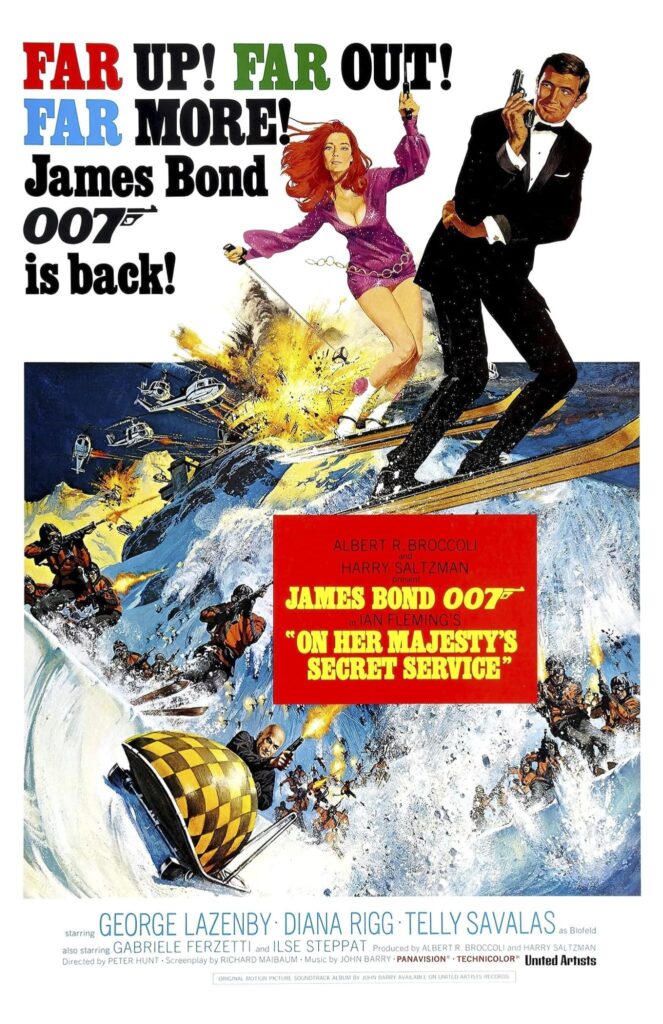
The story opens with Bond pursuing Ernst Stavro Blofeld, whose latest scheme involves biological warfare designed to threaten global agriculture. Blofeld has established his headquarters atop the Swiss Alps at Piz Gloria, posing as a genealogist while secretly brainwashing a group of women to carry out his plan. To infiltrate the operation, Bond goes undercover as Sir Hilary Bray, abandoning his usual reliance on gadgets and brute force in favor of disguise, deception, and psychological endurance. This emphasis on classic espionage grounds the film in realism while maintaining high stakes.
George Lazenby’s portrayal of Bond is notably different from his predecessors. His Bond is physically imposing yet emotionally open, capable of self-doubt, tenderness, and genuine connection. While Lazenby lacked Connery’s polish, his rawness suits the story being told. This is a Bond who questions his role, tires of the endless chase, and yearns for something beyond duty. The film even breaks the fourth wall briefly, acknowledging the character’s cinematic past, signaling that the franchise was aware of its own evolution.
At the heart of the film is Bond’s relationship with Tracy di Vicenzo, portrayed magnificently by Diana Rigg. Tracy is one of the most fully realized and emotionally complex women in the franchise. She is strong, wounded, intelligent, and independent—Bond’s equal rather than his accessory. Their romance develops gradually and convincingly, giving the film a genuine emotional core rarely seen in earlier Bond adventures. Tracy is not simply a love interest; she is the catalyst for Bond’s transformation.
Blofeld, played this time by Telly Savalas, is portrayed with a grounded physicality and ruthless pragmatism. Gone is the detached mastermind archetype; this Blofeld is hands-on, volatile, and dangerously human. His dynamic with Bond feels more personal and adversarial, reinforcing the film’s focus on character-driven conflict. The alpine setting enhances the menace, with sweeping mountain vistas contrasting sharply with the cold precision of Blofeld’s plan.
Visually, On Her Majesty’s Secret Service is one of the most striking Bond films of its era. The ski chases through the Alps are fast, brutal, and exhilarating, setting new standards for action choreography. The cinematography captures both intimacy and grandeur, while the editing—particularly during action sequences—feels modern and aggressive. John Barry’s score, featuring a powerful instrumental theme and the haunting love song “We Have All the Time in the World,” deepens the film’s emotional resonance and sense of tragedy.
The film’s final act delivers one of the most shocking and poignant endings in the entire franchise. Bond achieves victory over Blofeld, but at a devastating personal cost that permanently alters the character’s emotional landscape. The closing moments reject triumph in favor of grief and quiet devastation, subverting audience expectations and redefining what a Bond ending could be.
Today, On Her Majesty’s Secret Service is widely regarded as one of the boldest and most artistically significant Bond films. Its willingness to humanize James Bond, explore love and loss, and challenge the franchise’s established formula set it apart as a singular achievement. Though George Lazenby appeared only once as 007, his performance anchors a film that dared to ask a profound question: what happens when the world’s greatest spy allows himself to love—and what does it cost him when that love is taken away?
Did You Know:
- This was the only James Bond film starring George Lazenby, who turned down a multi-film contract believing the Bond role would become outdated in the 1970s.
- Diana Rigg was already a well-known star from The Avengers TV series and was paid more than Lazenby, making her one of the highest-paid actresses in the franchise at the time.
- The film was the first Bond movie to show Bond falling genuinely in love and getting married, a storyline directly adapted from Ian Fleming’s novel.
- Telly Savalas’s version of Blofeld was intentionally portrayed as more physical and hands-on, differing sharply from Donald Pleasence’s colder, more detached interpretation.
- Many of the ski chase sequences were groundbreaking, influencing the way action scenes were filmed and edited in later spy and action movies.
- The line “This never happened to the other fellow” was a subtle fourth-wall nod acknowledging Sean Connery’s departure.
- The instrumental main theme was unusual for a Bond film, as it did not feature vocals, relying instead on rhythm and brass to drive intensity.
- The film’s tragic ending was so unexpected that it confused and shocked audiences upon release, contributing to its mixed initial reception.
- Over time, the movie has undergone a major critical reappraisal and is now frequently ranked among the best Bond films ever made.
Diamonds Are Forever (1971) — Sean Connery
Diamonds Are Forever occupies a unique and often debated place in the James Bond canon, serving as both a tonal reset and a nostalgic reunion. Released in 1971, the film marked Sean Connery’s return to the role of James Bond after his absence in On Her Majesty’s Secret Service. Rather than continuing the emotional gravity and tragic consequences of its predecessor, Diamonds Are Forever pivots sharply toward wit, camp, and flamboyant spectacle. The result is a Bond film that feels deliberately lighter, embracing humor and excess at a time when the franchise was recalibrating its identity.
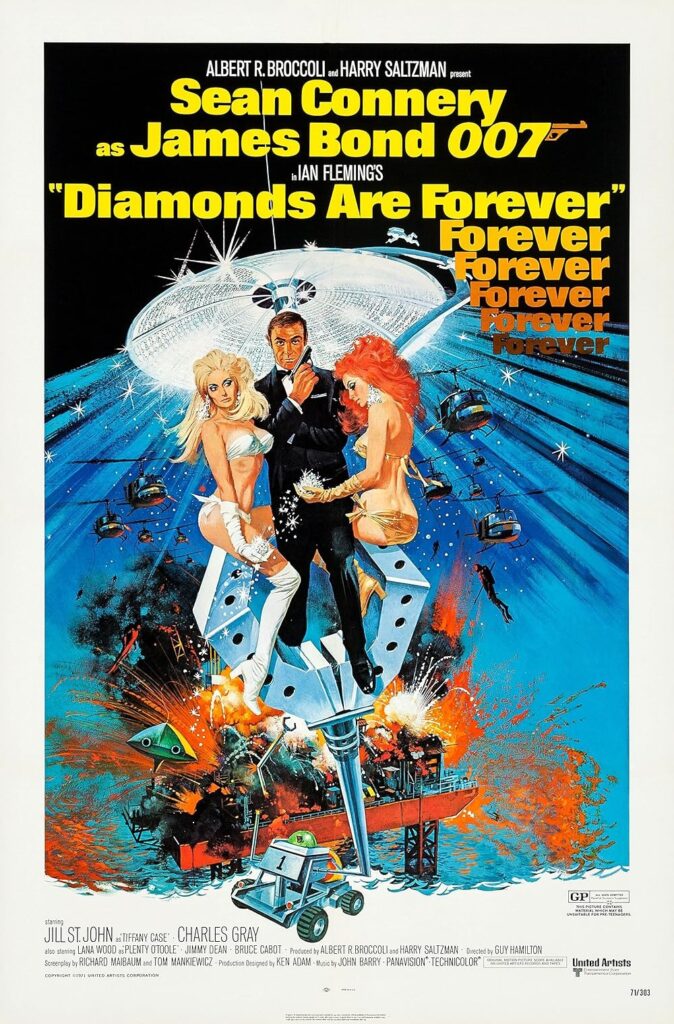
The story begins with Bond investigating a global diamond smuggling operation that leads him from Europe to the neon-lit excess of Las Vegas. What initially appears to be a criminal enterprise driven by greed soon reveals itself as another elaborate scheme orchestrated by Bond’s long-standing nemesis, Ernst Stavro Blofeld. Blofeld’s plan involves using a satellite-based laser weapon powered by diamonds to assert global dominance, blending science fiction ambition with comic-book villainy. The narrative unfolds more as a playful caper than a grounded spy thriller, favoring clever dialogue and outrageous scenarios over realism.
Sean Connery’s performance reflects this tonal shift. Older and more relaxed, Connery plays Bond with a knowing charm and wry humor, leaning into sarcasm rather than menace. This version of Bond feels less emotionally burdened and more amused by the absurdity around him. While some critics noted a lack of physical intensity compared to earlier films, Connery’s effortless screen presence and impeccable timing reaffirm why he defined the role in the first place.
Blofeld, portrayed this time by Charles Gray, is reimagined with a lighter, more theatrical flair. Gone is the physical brutality of Telly Savalas’s interpretation; instead, this Blofeld delights in deception, disguise, and ironic humor. The film even plays with the idea of multiple Blofeld doubles, reinforcing the character’s elusiveness while also leaning into self-parody. This interpretation aligns perfectly with the film’s overall tone, presenting the villain as entertaining as he is threatening.
One of the most memorable aspects of Diamonds Are Forever is its embrace of Las Vegas as a setting. The casinos, desert hideouts, and lavish interiors reflect early 1970s extravagance, giving the film a distinct visual identity. Supporting characters like the eccentric assassins Mr. Wint and Mr. Kidd add an offbeat, almost surreal quality to the story, becoming some of the franchise’s most unusual henchmen. Their quiet menace and dark humor perfectly encapsulate the film’s camp sensibility.
The Bond girl, Tiffany Case—portrayed by Jill St. John—begins as a sharp and capable smuggler, though her characterization becomes increasingly comedic as the film progresses. While her arc is uneven, she fits comfortably within the film’s playful atmosphere. John Barry’s score and Shirley Bassey’s sultry title song add polish and grandeur, grounding the film’s sillier moments in classic Bond elegance.
In its climax, Diamonds Are Forever delivers large-scale action with a wink, culminating in confrontations aboard oil rigs and desert installations. The stakes are global, but the tone never becomes heavy, reinforcing the idea that this Bond adventure is meant to entertain first and thrill second.
Today, Diamonds Are Forever is often viewed as a transitional film—a bridge between the emotional depth of On Her Majesty’s Secret Service and the lighter, more comedic direction that would define much of the Roger Moore era. While it may lack the gravitas of earlier entries, it succeeds as a stylish, irreverent farewell to Sean Connery’s original run as James Bond. For fans, it stands as a reminder that 007 can survive reinvention by embracing humor just as effectively as danger, proving once again that Bond always finds a way to adapt.
Did You Know:
- Diamonds Are Forever marked Sean Connery’s return to James Bond after a one-film absence, reportedly for a then-record-breaking salary.
- Connery donated a large portion of his earnings from the film to charitable causes, particularly in Scotland.
- Charles Gray, who played Blofeld in this film, had previously appeared in You Only Live Twice—but as a completely different character, making him one of the few actors to play multiple roles in the franchise.
- The film leaned heavily into camp and humor, helping set the tonal direction for the upcoming Roger Moore era.
- The eccentric assassins Mr. Wint and Mr. Kidd became cult favorites for their darkly comic and unconventional portrayal of Bond henchmen.
- Much of the Las Vegas footage was filmed inside real casinos, which was rare for major films at the time.
- Shirley Bassey became the only artist to perform three Bond theme songs, with “Diamonds Are Forever” being her second.
- The concept of multiple Blofeld doubles was introduced to explain the villain’s changing appearance across films.
- The climactic oil rig scenes were filmed on elaborate sets rather than real platforms, allowing for controlled large-scale action.
- Despite mixed critical reception, the film was a major box-office success, reaffirming James Bond’s enduring popularity.
Live and Let Die (1973) — Roger Moore
Live and Let Die marked a pivotal turning point in the James Bond franchise, introducing Roger Moore as 007 and signaling a bold shift in tone, style, and cultural influence. Released in 1973, the film arrived at a moment when audiences were moving away from Cold War rigidity toward grittier urban stories, mysticism, and countercultural themes. Rather than attempting to imitate Sean Connery’s portrayal, Live and Let Die reinvented Bond for a new era—leaner, more sardonic, and noticeably lighter in temperament, while still maintaining the character’s lethal competence.
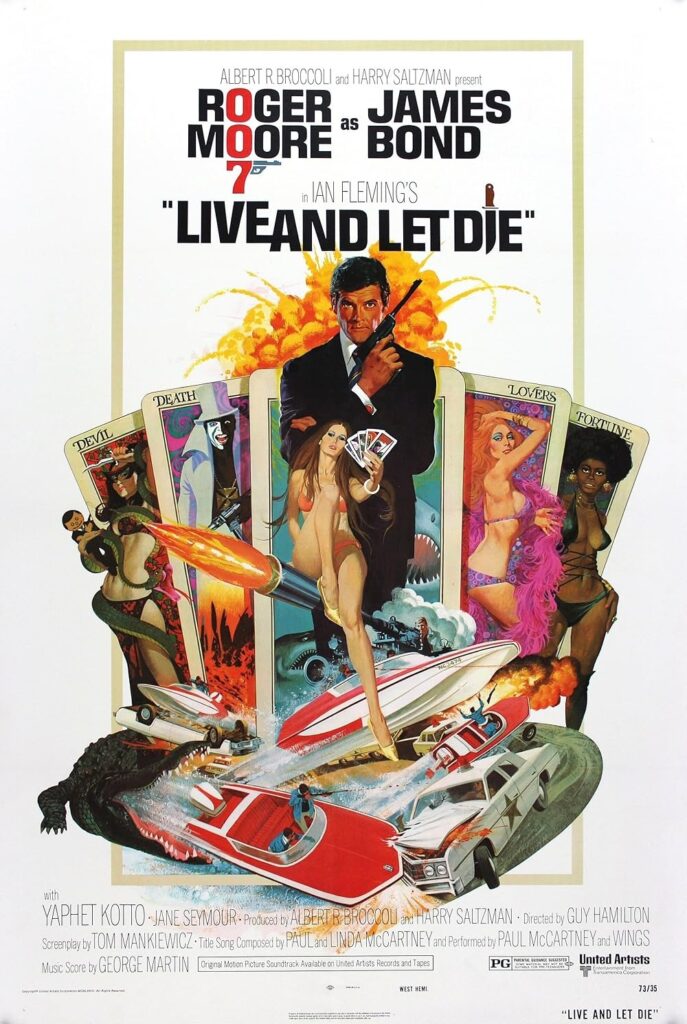
The plot plunges Bond into a web of assassinations connected to a powerful Caribbean dictator and crime lord known as Dr. Kananga, who also operates under the alter ego of Harlem drug kingpin Mr. Big. When multiple British agents are killed under mysterious circumstances, Bond traces the conspiracy from New York City to New Orleans and ultimately to the island of San Monique. The narrative blends espionage with voodoo imagery, political intrigue, and organized crime, creating one of the most unconventional storylines in the franchise.
Roger Moore’s debut performance establishes a markedly different Bond. His interpretation emphasizes charm, wit, and raised-eyebrow humor rather than brute intimidation. Moore’s Bond feels smoother and more ironic, often disarming enemies with confidence rather than aggression. This tonal recalibration allowed the franchise to evolve without losing its core identity, setting the stage for Moore’s long and successful tenure. While less emotionally intense than later portrayals, his Bond is supremely watchable and self-aware.
Yaphet Kotto’s dual-role villain, Dr. Kananga/Mr. Big, is one of the franchise’s most distinctive antagonists. Combining political authority with criminal ambition, Kananga’s plan to flood the United States with free heroin—thereby destroying rival drug operations before monopolizing the market—was surprisingly grounded in real-world logic. Kotto brings intelligence and menace to the role, crafting a villain who is calm, calculating, and ruthless without resorting to theatrical excess.
Jane Seymour’s Solitaire adds an ethereal, almost tragic dimension to the film. Gifted with psychic abilities through tarot cards, Solitaire lives under Kananga’s control, her powers exploited for strategic advantage. Her relationship with Bond becomes a story of liberation and vulnerability, and Seymour’s performance lends sincerity to a character rooted in mysticism. Solitaire stands out as one of the more memorable Bond heroines of the 1970s due to her emotional depth and narrative importance.
Visually, Live and Let Die is rich with atmosphere. Harlem streets, Louisiana bayous, and Caribbean landscapes give the film a gritty, exotic texture distinct from earlier European-focused Bond entries. The action sequences—particularly the iconic speedboat chase through the Louisiana swamps—are energetic, inventive, and grounded in physical stunt work. These moments reinforce the franchise’s growing emphasis on spectacle while maintaining a sense of real danger.
Musically, the film makes history with its title song, “Live and Let Die,” written and performed by Paul McCartney and Wings. The song broke tradition by fusing rock music with orchestral elements, expanding the sonic identity of Bond films and influencing every theme song that followed. George Martin’s score complements this innovation, weaving tension and rhythm into the film’s unique atmosphere.
In its climax, Live and Let Die embraces theatricality and excess, delivering a finale that is memorable, shocking, and unmistakably of its era. While the tone occasionally borders on surreal, the conclusion reinforces Bond’s role as a destabilizing force against corruption and tyranny.
Today, Live and Let Die is remembered as a daring reinvention—a film that proved James Bond could evolve with changing times and tastes. It launched Roger Moore’s era with confidence, expanded the franchise’s stylistic range, and demonstrated that 007 could survive cultural shifts without losing his iconic appeal. As a result, it remains one of the most distinctive and influential Bond films ever made.
Did You Know:
- Live and Let Die was Roger Moore’s first appearance as James Bond, and he deliberately avoided imitating Sean Connery, opting for a lighter, more humorous take on the character.
- The title song “Live and Let Die” by Paul McCartney and Wings was the first rock song used as a Bond theme, breaking with orchestral tradition and reshaping the franchise’s musical identity.
- Jane Seymour was only 20 years old during filming, making her one of the youngest leading ladies in Bond history.
- Yaphet Kotto’s villain, Dr. Kananga/Mr. Big, was one of the first Bond villains rooted in contemporary drug trafficking, reflecting early 1970s social concerns.
- The famous Louisiana bayou boat chase set a Guinness World Record at the time for the longest continuous speedboat jump captured on film.
- The film makes heavy use of voodoo imagery, though much of it was stylized for cinematic effect rather than cultural accuracy.
- The New Orleans funeral parade scene was filmed without permits, using real bystanders who were unaware a movie was being shot.
- This was the last Bond film to prominently feature Felix Leiter as a major ally until later franchise revivals.
- Despite mixed reviews on release, Live and Let Die was a major box-office success, proving audiences were ready to accept a new James Bond.
The Man with the Golden Gun (1974) — Roger Moore
The Man with the Golden Gun occupies a distinctive place in the James Bond franchise as a more intimate, character-driven entry set against the backdrop of Roger Moore’s early tenure as 007. Released in 1974, the film follows the bold reinvention begun with Live and Let Die but shifts focus away from large-scale conspiracies toward a personal duel between two professional killers. At its core, the film explores the idea of Bond confronting a dark reflection of himself—an assassin who is just as skilled, intelligent, and deadly, but completely unburdened by morality.
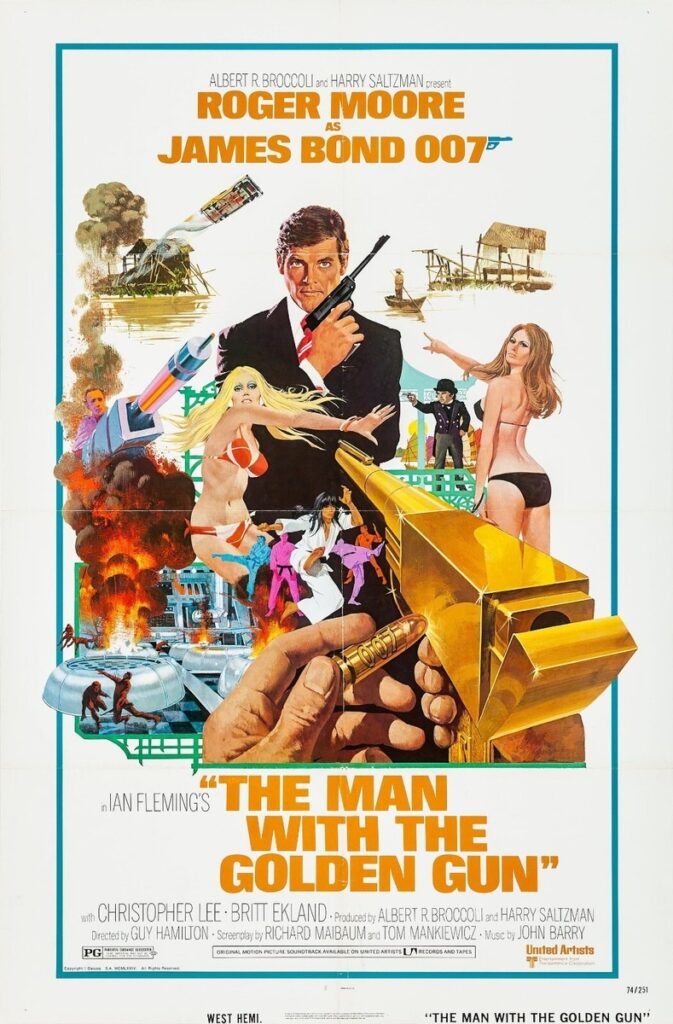
The story begins when MI6 receives a chilling message: a bullet engraved with “007,” signaling that James Bond has been marked for death. The sender is Francisco Scaramanga, the world’s most feared and expensive assassin, who kills purely for sport, pride, and profit. Bond’s mission quickly transforms from intelligence gathering into a deadly cat-and-mouse pursuit that spans Hong Kong, Macau, Thailand, and remote islands in the Far East. Rather than racing to stop a global catastrophe, Bond is forced into a personal contest where survival itself is the prize.
Roger Moore’s Bond continues to define his interpretation of the character here, blending charm, irony, and composure under pressure. Moore plays Bond as confident and cerebral, using wit and misdirection rather than brute force. In this film especially, Bond’s intelligence is foregrounded, as he must match Scaramanga not only physically but psychologically. The lighter tone of Moore’s performance contrasts sharply with the film’s darker thematic undercurrent, creating an intriguing tension between humor and danger.
Christopher Lee’s portrayal of Francisco Scaramanga is widely regarded as the film’s greatest strength. Lee brings elegance, menace, and intellectual curiosity to the role, crafting one of the franchise’s most fascinating villains. Scaramanga sees Bond as a worthy adversary, not an enemy—someone who validates his own sense of superiority. Their relationship is less hero versus villain and more predator versus predator, culminating in a climactic showdown that strips away gadgets, armies, and spectacle in favor of pure skill and instinct.
The Golden Gun itself becomes a powerful symbol within the narrative. Assembled from everyday objects—a pen, a cigarette case, a lighter, and a cufflink—the weapon reflects Scaramanga’s precision and ingenuity. It reinforces the film’s emphasis on individuality and craftsmanship rather than overwhelming force. The duel between Bond and Scaramanga, staged within a hall-of-mirrors funhouse, is one of the most psychologically charged finales in the series, forcing Bond to confront not only his opponent but his own identity as a killer.
Visually, The Man with the Golden Gun embraces exotic locations and vibrant color palettes, showcasing Asia through a 1970s cinematic lens. From bustling cityscapes to sunlit islands, the settings provide a rich backdrop that enhances the film’s sense of isolation and pursuit. The energy crisis subplot—centered on a powerful solar energy device known as the Solex Agitator—grounds the story in contemporary concerns, even if it ultimately serves as a secondary thread to the Bond–Scaramanga rivalry.
The film’s supporting characters add texture and contrast. Britt Ekland’s Mary Goodnight provides comedic relief, while Maud Adams’s Andrea Anders brings tragedy and emotional weight, representing the human cost of Scaramanga’s ambition. Nick Nack, Scaramanga’s diminutive accomplice, adds an unsettling unpredictability that reinforces the villain’s eccentricity.
In its final moments, The Man with the Golden Gun resolves its central question: what separates James Bond from the men he hunts? Bond survives not because he is the better killer, but because he retains a moral compass—however faint—that Scaramanga lacks. This distinction gives the film a philosophical edge rarely explored so directly in the franchise.
Today, The Man with the Golden Gun is often viewed as an underappreciated Bond entry. While it lacks the epic scale of other films, its focus on character, identity, and personal conflict makes it a compelling chapter in the series. It stands as a thoughtful exploration of Bond’s dual nature—both protector and assassin—and remains one of the most intriguing psychological duels in 007 history.
Did You Know:
- Christopher Lee, who played Francisco Scaramanga, was Ian Fleming’s real-life cousin and had long been Fleming’s personal choice to portray a Bond villain.
- The idea of Scaramanga as Bond’s dark mirror was intentional, making this one of the few Bond films centered on a personal duel rather than a world-ending threat.
- The famous Golden Gun was designed to be assembled from everyday objects, symbolizing precision and craftsmanship rather than brute power.
- The climactic funhouse duel between Bond and Scaramanga is one of the most psychologically driven finales in the series, emphasizing skill and strategy over spectacle.
- The energy crisis subplot involving the Solex Agitator was inspired by real-world 1970s concerns over oil shortages and alternative energy.
- Britt Ekland’s character, Mary Goodnight, was intentionally written as more comedic, contrasting sharply with the darker tone of the Bond–Scaramanga rivalry.
- Maud Adams, who played Andrea Anders, later returned to the franchise as the lead Bond girl in Octopussy, making her one of the few actresses to appear in multiple Bond films.
- The iconic car stunt jump—the corkscrew bridge leap—was performed for real and became one of the most technically impressive stunts of its time.
- Despite mixed critical reception, the film has gained appreciation over time for its strong villain performance and introspective take on James Bond.
The Spy Who Loved Me (1977) — Roger Moore
The Spy Who Loved Me is widely celebrated as the defining triumph of Roger Moore’s era and one of the most confident reinventions in the franchise’s history. Arriving after a period of uneven reception, the film restored Bond’s sense of grandeur with a perfect blend of spectacle, romance, humor, and global stakes. It feels expansive without losing clarity, playful without sacrificing tension, and modern while honoring the classic Bond DNA—qualities that helped reassert 007 as cinema’s premier adventure hero.
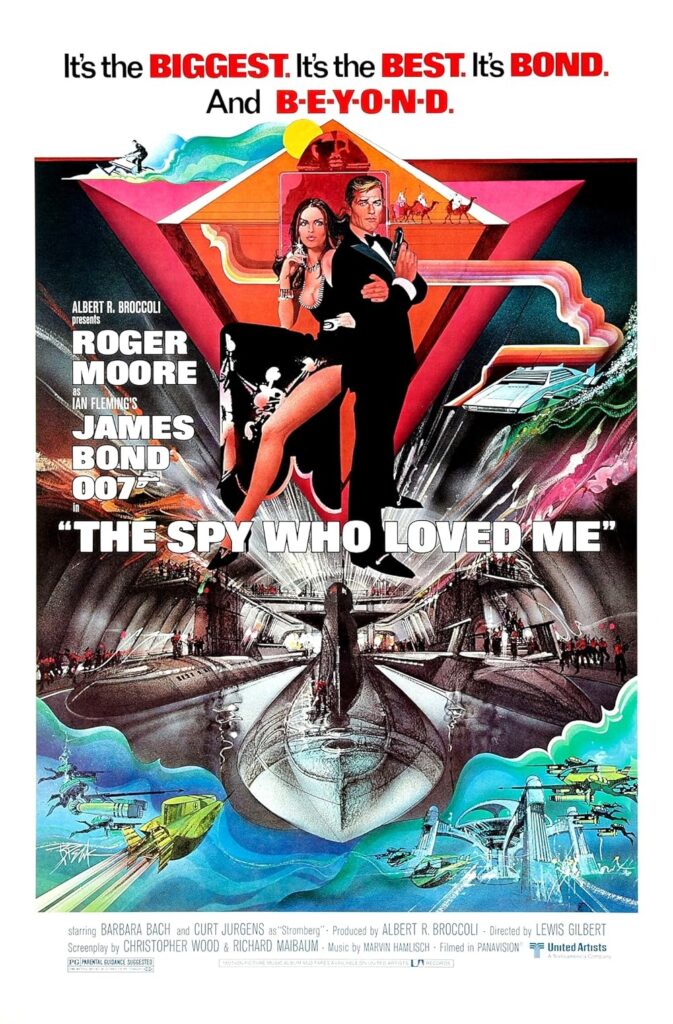
The plot launches with an audacious premise: British and Soviet nuclear submarines are vanishing without a trace, threatening to destabilize the balance of power and ignite global conflict. Forced into an uneasy alliance, James Bond teams up with Soviet agent Anya Amasova to uncover the truth behind the disappearances. Their investigation spans deserts, oceans, and fortified lairs, gradually revealing a single mastermind orchestrating chaos from the shadows. The narrative smartly frames espionage as a high-stakes chess match, where cooperation is as dangerous as confrontation.
Roger Moore’s Bond reaches full maturity here. His portrayal balances wit, elegance, and authority, projecting effortless confidence without drifting into parody. Moore’s Bond is a consummate professional—calm under pressure, sharp in dialogue, and decisive in action. Importantly, the film allows Bond to be emotionally challenged as well as physically tested, particularly through his evolving relationship with Anya, which adds depth and credibility to the story.
Barbara Bach’s Anya Amasova is one of the franchise’s strongest and most competent leading women. As Bond’s equal and occasional rival, Anya brings intelligence, poise, and moral conviction to the screen. Their dynamic is layered with mutual respect, flirtation, and unresolved tension, especially when Anya learns of Bond’s role in her lover’s death. This emotional undercurrent gives the film a seriousness beneath its spectacle and elevates the central partnership beyond mere romance.
The villain, Karl Stromberg—portrayed with icy detachment by Curd Jürgens—embodies the Bond archetype of the detached visionary with apocalyptic ambitions. Stromberg’s goal is nothing less than the destruction of the world’s surface civilization, to be replaced by a new society beneath the sea. His underwater city, Atlantis, is one of the franchise’s most imaginative villain lairs, representing the series’ renewed commitment to bold, imaginative world-building. Complementing Stromberg is his henchman Jaws, played by Richard Kiel, whose towering presence and steel teeth made him instantly iconic and unforgettable.
Visually and technically, The Spy Who Loved Me is a landmark. The opening ski sequence—culminating in Bond’s Union Jack parachute jump—is one of the most famous stunts in movie history. The film’s action set pieces are grand but cleanly staged, from high-speed chases to massive naval confrontations. Marvin Hamlisch’s score and Carly Simon’s theme song, “Nobody Does It Better,” lend the film a romantic sweep that perfectly matches its scale and ambition.
In the climactic final act, the film delivers one of the franchise’s most satisfying payoffs. Bond’s infiltration of Atlantis and the ensuing battle between superpowers underscore the story’s central theme: cooperation, even among enemies, is essential to survival. The resolution balances spectacle with character, ensuring that the film ends not only with victory, but with emotional closure.
Today, The Spy Who Loved Me is often cited as the gold standard of the Moore era and a top-tier Bond film overall. It refined the franchise’s formula at a moment when it could have drifted into excess, proving that James Bond could be thrilling, romantic, humorous, and epic all at once. More than forty years later, it remains a masterclass in how to blend escapism with craftsmanship—an enduring reminder that, when done right, nobody does it better.
Did You Know:
- The opening ski jump with the Union Jack parachute is often ranked as one of the greatest stunts in movie history and instantly signaled Bond’s return to large-scale spectacle.
- This was the first Bond film to be officially co-produced with the Soviet Union’s cooperation, reflected in the unusually positive portrayal of a Soviet agent as Bond’s equal.
- Barbara Bach’s character, Anya Amasova, was written as a true counterpart to Bond, not a sidekick, making her one of the most competent Bond women of the era.
- Richard Kiel’s henchman Jaws became so popular that he was brought back for Moonraker, making him one of the few Bond henchmen to appear in multiple films.
- The underwater city Atlantis was one of the largest sets ever built for a Bond film at the time, reinforcing the franchise’s renewed commitment to epic world-building.
- Carly Simon’s theme song “Nobody Does It Better” was the first Bond theme to be nominated for an Academy Award.
- Roger Moore later said this film best represented his ideal version of James Bond, balancing humor, romance, and authority.
- The tanker finale required miniatures, massive sets, and full-scale submarines, making it one of the most technically complex climaxes in the series.
- The film helped restore critical and audience confidence in the Bond franchise after the mixed reception of earlier 1970s entries.
Moonraker (1979) — Roger Moore
Moonraker stands as the most audacious and polarizing entry of Roger Moore’s James Bond era, boldly pushing the franchise beyond Earth and into full-blown science-fiction spectacle. Released at the height of the late-1970s fascination with space exploration—just two years after Star Wars reshaped blockbuster cinema—Moonraker represents the moment when Bond fully embraced excess, scale, and fantasy. It is a film that unapologetically aims for wonder over realism, expanding the boundaries of what a James Bond adventure could be.
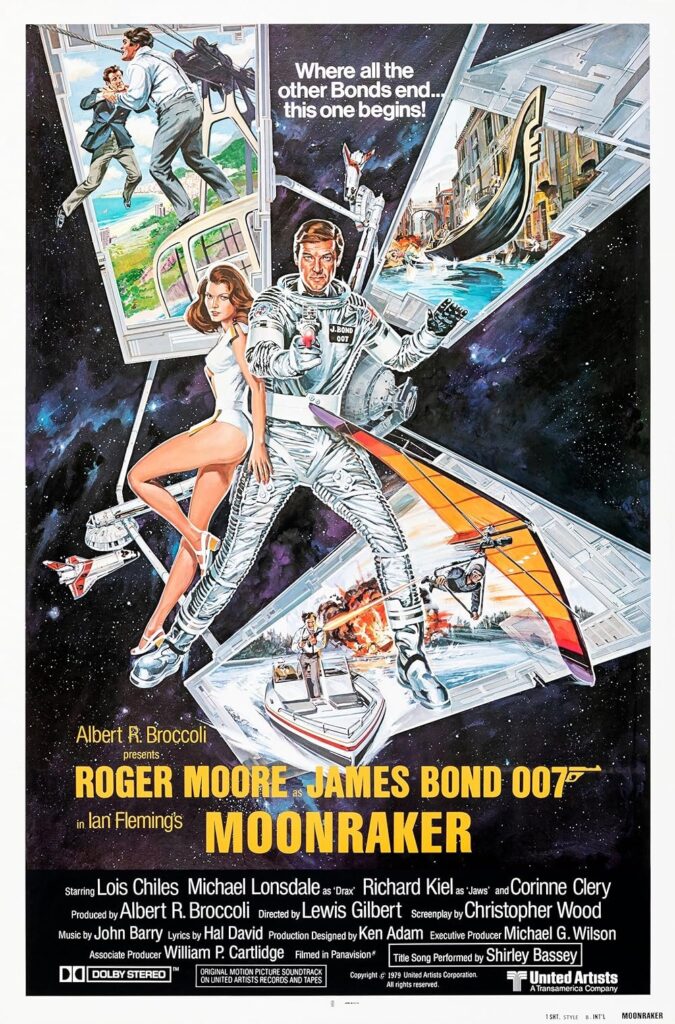
The story begins with the mysterious hijacking of a Moonraker space shuttle during transit to England, drawing Bond into an investigation that spans continents and eventually orbits the planet itself. His search leads to billionaire industrialist Hugo Drax, whose pristine corporate image conceals a chillingly grand vision for humanity’s future. As Bond follows the trail from California to Venice, Rio de Janeiro, and the Amazon rainforest, the film steadily escalates from espionage thriller to cosmic apocalypse, revealing one of the most ambitious villain plots in the franchise.
Roger Moore’s Bond is fully settled into his role by this point, delivering a confident, polished performance that leans into charm and irony rather than intensity. Moore plays Bond as an unflappable constant amid increasingly outrageous circumstances, grounding the film’s most extravagant moments with wit and composure. His lighthearted tone acts as a stabilizing force, allowing the audience to accept laser guns, zero-gravity combat, and space stations without losing the essence of the character.
Hugo Drax, portrayed with cold precision by Michael Lonsdale, is a quintessential Bond megalomaniac. Soft-spoken and eerily polite, Drax plans to wipe out Earth’s population using a nerve gas released from orbit, repopulating the planet with a genetically “perfect” master race. His motivation is chilling precisely because of its calm logic and elitism. Drax’s serene demeanor contrasts sharply with the enormity of his plan, making him one of the franchise’s most quietly disturbing villains.
The film’s sense of spectacle is unmatched in the classic era. Lavish sets, exotic locations, and elaborate visual effects dominate the experience, from gondola chases through Venice to cable-car fights above Rio. The climax—a full-scale laser battle in space between Drax’s forces and Earth’s military—was unprecedented for the series and remains one of its most visually ambitious moments. John Barry’s sweeping score, infused with futuristic elements, reinforces the film’s grand, almost operatic tone.
Returning characters also play a significant role in Moonraker. Lois Chiles’s Dr. Holly Goodhead provides a capable, intelligent partner for Bond, while Richard Kiel’s Jaws undergoes a surprising transformation. Once a terrifying henchman, Jaws becomes an unlikely ally, adding humor and heart to the film. His arc reflects Moonraker’s overall shift toward a more playful, audience-friendly approach.
Critically, Moonraker has long divided fans and reviewers. Some view it as the franchise’s most excessive detour, abandoning espionage roots in favor of trend-chasing spectacle. Others appreciate it as a confident, self-aware escalation that understands its own absurdity. Regardless of perspective, the film’s box-office success demonstrated that audiences were more than willing to follow Bond wherever he went—even into space.
Today, Moonraker is best understood as a time capsule of late-1970s blockbuster ambition and a testament to the franchise’s adaptability. It represents the outer limit of Bond excess, a moment when the series tested how far it could stretch without breaking. Whether admired or criticized, Moonraker remains unforgettable—a cinematic declaration that James Bond, like the space age itself, knew no bounds.
Did You Know:
- Moonraker was made in direct response to the success of Star Wars, making it the most overtly science-fiction–inspired Bond film ever produced.
- At the time of release, it was the most expensive James Bond movie, with its massive sets, visual effects, and space sequences driving costs sky-high.
- The space station interior was one of the largest sets ever built at Pinewood Studios, pushing practical set design to its limits.
- Roger Moore performed none of the spacewalk scenes, which relied entirely on wire work, miniatures, and visual effects specialists.
- Richard Kiel’s character Jaws was originally meant to remain a villain, but audience popularity led to his surprise redemption arc.
- The laser guns used in the space battle were designed to look futuristic yet avoid sounding realistic, emphasizing fantasy over realism.
- The gondola chase in Venice originally involved a hovercraft conversion purely to escalate spectacle and humor.
- Despite mixed critical reviews, Moonraker became the highest-grossing Bond film of its era, proving its appeal with audiences worldwide.
- Ian Fleming’s original Moonraker novel had no space storyline at all, making this one of the loosest adaptations in the franchise.
- The film marked the outermost boundary of Bond excess, prompting later films to deliberately return the series to a more grounded tone.
For Your Eyes Only (1981) — Roger Moore
For Your Eyes Only represents a deliberate and refreshing course correction for the James Bond franchise, pulling 007 back from the outer reaches of space and returning him to a more grounded, suspense-driven form of espionage. Released in 1981 after the extravagance of Moonraker, the film signaled a tonal reset for Roger Moore’s Bond—one that emphasized realism, personal stakes, and physical danger over fantasy and spectacle. The result is a leaner, more serious adventure that reminded audiences that James Bond works best when danger feels immediate and consequences feel real.
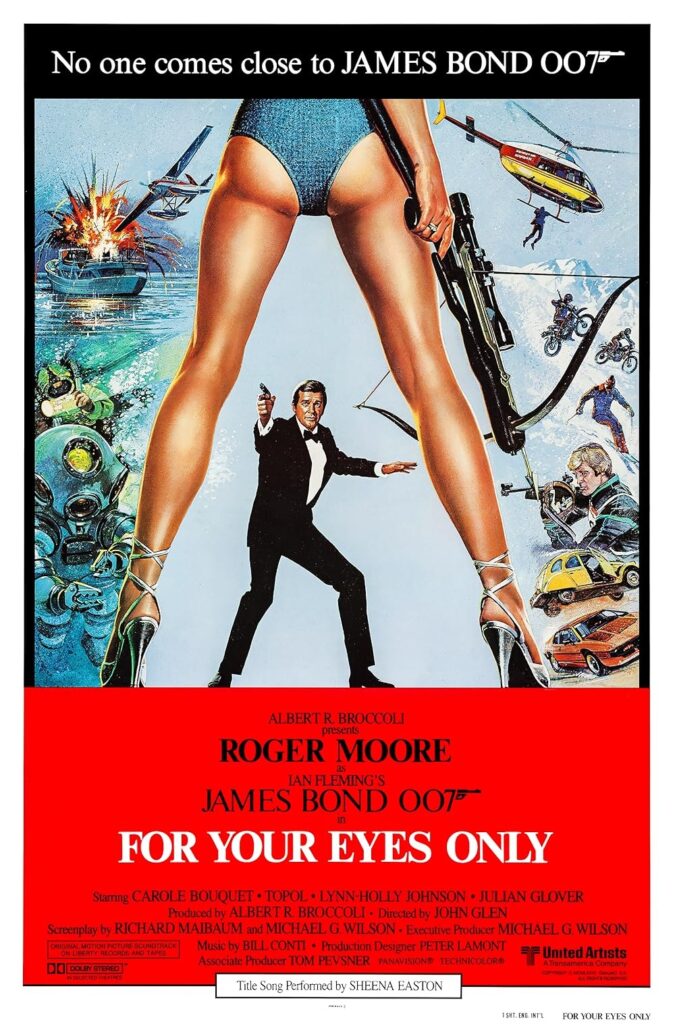
The story is set in motion when a British intelligence ship sinks in the Ionian Sea, taking with it a top-secret missile command system known as ATAC. If recovered by hostile forces, the device could compromise NATO’s nuclear defenses and destabilize the global balance of power. Bond is assigned to locate the system before it falls into enemy hands, but his mission quickly intertwines with a deeply personal quest for vengeance led by Melina Havelock, the daughter of a murdered marine archaeologist. This dual narrative—global security and personal revenge—gives the film a strong emotional backbone.
Roger Moore delivers one of his most restrained and effective performances as Bond. Gone is much of the tongue-in-cheek excess of earlier entries; instead, Moore portrays a seasoned agent who is calm, focused, and occasionally ruthless. His Bond is more pragmatic and less playful, allowing moments of moral ambiguity and emotional gravity to surface. The pre-title sequence, which brutally dispatches a familiar adversary, makes it immediately clear that this film intends to operate on a harsher, more realistic wavelength.
Carole Bouquet’s Melina Havelock is central to the film’s tone and success. Unlike many earlier Bond heroines, Melina is driven by grief, anger, and determination rather than romance. Her quest for revenge parallels Bond’s mission and forces him into the role of moral counterbalance, repeatedly warning her about the cost of vengeance. Their relationship is defined more by mutual respect and restraint than flirtation, reinforcing the film’s serious approach to character and theme.
The villains of For Your Eyes Only are grounded and politically plausible. Julian Glover’s Aristotle Kristatos is a calculating arms dealer whose allegiance shifts according to profit rather than ideology, embodying the moral ambiguity of Cold War espionage. His rival, the ruthless Milos Columbo, blurs the line between ally and adversary, creating a narrative where trust is constantly in question. This absence of a single flamboyant supervillain reinforces the film’s realistic tone, emphasizing espionage as a shadowy world of competing interests rather than theatrical evil.
Visually, the film stands out for its emphasis on physical realism and practical stunts. Ski chases, underwater sequences, and the iconic mountain-climbing finale are tense, dangerous, and impressively staged. The rock-climbing ascent of St. Cyril’s monastery—shot with minimal safety equipment—remains one of the most suspenseful sequences in the entire franchise. These moments underscore Bond’s vulnerability, showing him relying on endurance and ingenuity rather than gadgets or luck.
Musically, Bill Conti’s score blends classical orchestration with subtle modern elements, while the title song “For Your Eyes Only” adds a soft, introspective quality that complements the film’s emotional focus. Together, the music and visuals reinforce a sense of intimacy and seriousness rarely seen in the Moore era.
In its final act, For Your Eyes Only delivers a conclusion that emphasizes principle over power. Bond chooses denial over domination, preventing the ATAC system from being exploited rather than claiming it for himself. This choice reinforces the film’s central theme: restraint, not spectacle, is what ultimately preserves stability.
Today, For Your Eyes Only is widely regarded as one of the strongest and most mature entries of the Roger Moore era. It proved that the franchise could successfully recalibrate after excess, balancing action, emotion, and realism without losing its identity. In doing so, the film reaffirmed James Bond not as a fantasy figure, but as a skilled operative navigating a dangerous, morally complex world—one wrong move away from disaster.
Did You Know:
- For Your Eyes Only was a deliberate tonal reset after Moonraker, with producers explicitly aiming to return Bond to realism and Cold War–style espionage.
- The brutal pre-title sequence was intended as a symbolic farewell to the excesses of earlier films and to close the chapter on Blofeld-style supervillainy.
- Roger Moore has said this was one of his favorite Bond performances, as it allowed him to play the character with greater seriousness and restraint.
- The famous mountain-climbing finale at St. Cyril’s monastery was filmed with minimal safety harnesses, making it one of the most dangerous stunt sequences in the franchise.
- Carole Bouquet’s Melina Havelock was written as a revenge-driven character, reversing the usual Bond dynamic by having 007 act as the moral restraint.
- The ATAC device plot was rooted in real Cold War fears about nuclear command-and-control technology falling into enemy hands.
- The film features no Q Branch gadget briefing, reinforcing its grounded, no-nonsense tone.
- Lynn-Holly Johnson, who played ice skater Bibi Dahl, was a real Olympic-level skater, cast to add authenticity to the winter sports sequences.
- The decision to destroy the ATAC system rather than use it marked one of the most ethically decisive endings in the Bond series.
- Many fans and critics now rank For Your Eyes Only as the strongest “serious” entry of the Roger Moore era.
Octopussy (1983) — Roger Moore
Octopussy is one of the most tonally complex entries in the James Bond franchise, blending Cold War intrigue, globe-trotting spectacle, and moments of overt humor into a single, ambitious adventure. Released in 1983 during the height of Roger Moore’s tenure as 007, the film reflects a franchise confident in its longevity but still navigating the balance between seriousness and spectacle. Positioned between the grounded realism of For Your Eyes Only and the escalating excess of later Moore-era films, Octopussy occupies a fascinating middle ground.
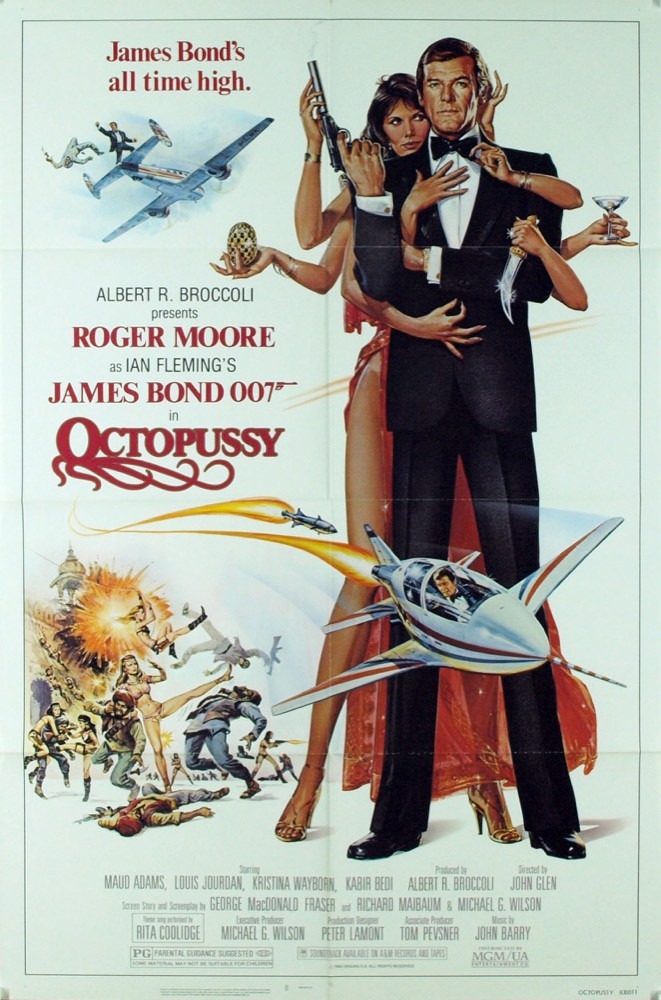
The story begins with the mysterious death of fellow British agent 009, whose final moments involve a Fabergé egg and a desperate attempt to escape across East Germany dressed as a clown. Bond is assigned to investigate the egg, which leads him into a tangled web of deception involving an exiled Afghan prince, Kamal Khan, and a wealthy, enigmatic woman known only as Octopussy. As Bond traces the trail from London to India and Eastern Europe, he uncovers a far more dangerous plot—one that threatens to destabilize NATO and ignite nuclear catastrophe.
Roger Moore’s Bond in Octopussy is at his most versatile. He moves effortlessly between charm, menace, and self-aware humor, often within the same sequence. Moore’s relaxed confidence anchors the film, allowing it to shift tones without completely losing cohesion. While moments like the clown disguise became controversial, Moore’s performance sells the urgency beneath the absurdity, reinforcing Bond as a professional agent willing to endure humiliation to stop disaster.
Maud Adams delivers a commanding performance as Octopussy, making her one of the most memorable and authoritative women in the franchise. Far from a passive love interest, Octopussy is a powerful leader who commands a network of women and operates independently of Bond. Her gradual realization that she is being manipulated gives the character emotional depth, and her alliance with Bond feels earned rather than assumed. Adams’ presence adds gravitas and elegance to a film that might otherwise tip too far into parody.
The villainous force in Octopussy is divided between Kamal Khan and the more ideologically driven General Orlov. Khan, portrayed with smooth arrogance, represents greed and self-interest, while Orlov embodies Cold War fanaticism and reckless ambition. Their plan—to detonate a nuclear weapon on a U.S. airbase and force unilateral disarmament in Western Europe—grounds the film in genuine geopolitical anxiety, giving real stakes to its most outlandish moments.
Visually, Octopussy is rich with color, texture, and variety. Indian palaces, bustling bazaars, luxury trains, and East German military installations give the film a sweeping international feel. The action sequences are inventive and varied, from rooftop chases to jungle pursuits and the now-iconic train scenes. The climactic sequence, with Bond racing against time to defuse a nuclear bomb, injects real tension and urgency, reminding audiences that beneath the humor lies a genuine thriller.
John Barry’s score supports this balance of tone, pairing lush romantic themes with sharp suspense cues. The title song “All Time High” reinforces the film’s emotional undercurrent, emphasizing romance and reflection rather than bombast. Together, the music and cinematography help smooth the tonal shifts that define the film.
In its final act, Octopussy delivers a satisfying convergence of spectacle and resolution. Bond prevents catastrophe not through overwhelming force, but through persistence, ingenuity, and timing. The alliance between Bond and Octopussy ultimately restores balance, reinforcing one of the film’s quieter themes: trust must be earned, even in a world built on deception.
Today, Octopussy is often reassessed as a more nuanced Bond film than its reputation suggests. While remembered by some for its flamboyant moments, it also contains sharp espionage, political relevance, and one of the franchise’s strongest female leads. As part of the Roger Moore era, it stands as a reminder that James Bond can be playful without being trivial—and that even amid spectacle, the threat of global disaster is never far away.
Did You Know:
- Octopussy was released the same year as the unofficial Bond film Never Say Never Again, resulting in a rare “Bond vs Bond” box-office rivalry—Octopussy ultimately earned more worldwide.
- The infamous clown disguise sequence was intended to heighten suspense by placing Bond in a situation of maximum humiliation rather than comedy, though it remains one of the most controversial moments in the franchise.
- Maud Adams became one of the few actresses to play a major role in multiple Bond films, having previously appeared as Andrea Anders in The Man with the Golden Gun.
- The film’s nuclear bomb plot was inspired by real Cold War fears about unilateral disarmament and escalating East–West tensions in Europe.
- Roger Moore performed many of his own stunts, including sequences on top of a moving train, despite being in his mid-50s at the time.
- The title “Octopussy” was taken directly from a short story by Ian Fleming, though the film’s plot is largely original.
- The Fabergé egg storyline required multiple custom-made replicas, some of which were highly detailed and expensive props.
- John Barry’s theme “All Time High” was one of the softest and most romantic Bond title songs, contrasting sharply with the film’s high-stakes nuclear threat.
- The film marked the final appearance of General Gogol, a recurring Soviet official who had appeared in multiple Bond films, signaling a shift in Cold War portrayals.
- Despite mixed critical reviews, Octopussy was a major commercial success, reinforcing Roger Moore’s popularity as James Bond.
A View to a Kill (1985) — Roger Moore
A View to a Kill serves as both a grand finale and a transitional moment for the James Bond franchise, marking Roger Moore’s final appearance as 007 after a record seven films. Released in 1985, the movie embraces the heightened style and spectacle of the mid-1980s while signaling the end of an era defined by charm, wit, and playful excess. Though often debated among fans, A View to a Kill stands out for its bold villain, striking locations, and an unmistakable sense of cinematic farewell.
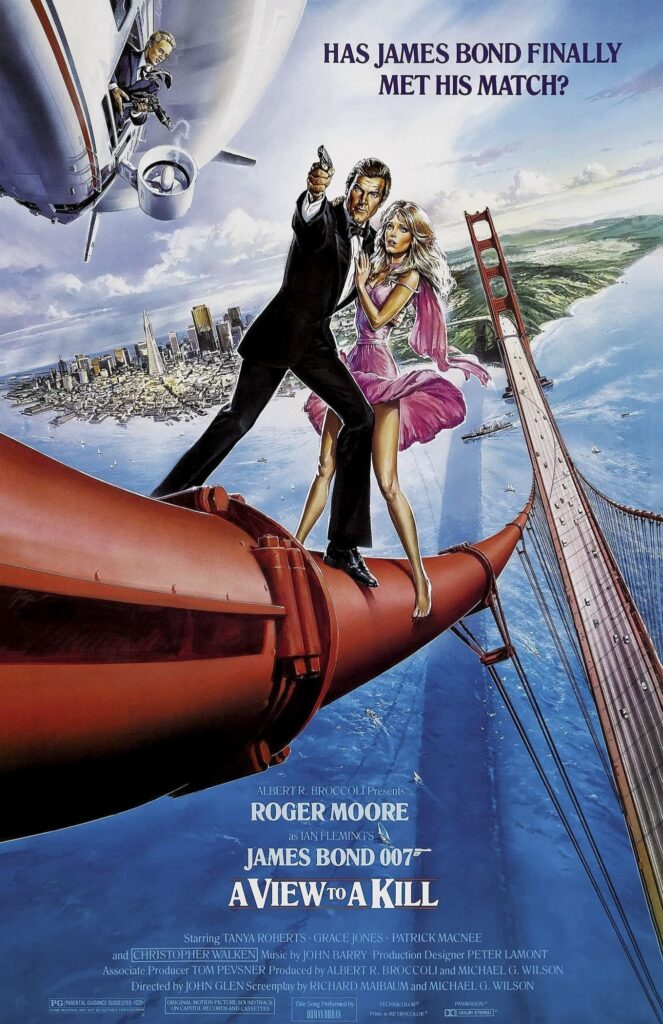
The story centers on a chillingly modern threat: the manipulation of global technology and finance. Bond investigates industrialist Max Zorin, whose meteoric rise in the microchip industry raises suspicions within British intelligence. What begins as corporate espionage escalates into a plan of mass destruction when Zorin’s true ambition is revealed—to obliterate California’s Silicon Valley through engineered seismic disaster, eliminating competitors and securing total dominance over the world’s computer markets. This plot grounds the film in 1980s anxieties about technology, power, and unchecked capitalism, giving it a surprisingly forward-looking edge.
Roger Moore’s Bond is noticeably older but no less composed. His performance leans heavily on experience, intelligence, and presence rather than physical dominance. Moore plays Bond as a seasoned operative navigating a world that is beginning to move faster than he does, which adds an unintended but poignant layer to the character. While the action demands occasionally highlight the age gap, Moore’s trademark elegance and humor remain intact, providing continuity and warmth as the franchise prepares to move on.
Christopher Walken delivers one of the most memorable villain performances in the entire Bond series as Max Zorin. Cold, unhinged, and gleefully cruel, Zorin is a product of Nazi experimentation who embodies chaos masked by corporate respectability. Walken’s eccentric intensity gives the character an unpredictable edge, making him both fascinating and terrifying. His sadistic delight in destruction marks a departure from more reserved villains, injecting the film with manic energy whenever he appears on screen.
Equally unforgettable is Grace Jones as May Day, Zorin’s powerful and imposing enforcer. Jones brings physicality, charisma, and menace to the role, making May Day one of the franchise’s most iconic henchwomen. Her eventual moral reckoning adds emotional weight to the story, transforming her from a symbol of brute force into a tragic figure who chooses humanity over loyalty to destruction.
Visually, A View to a Kill is rich with iconic imagery. From snowy chases in Siberia to lavish Parisian sequences and the climactic confrontation atop San Francisco’s Golden Gate Bridge, the film fully embraces its international scope. The action set pieces—particularly the bridge fight—are tense, vertical, and visually striking, reinforcing the sense that Bond is quite literally battling forces intent on reshaping the world.
The film’s musical identity is one of its strongest elements. Duran Duran’s title song, “A View to a Kill,” became a global hit and remains the only Bond theme to reach number one on the U.S. Billboard charts. John Barry’s final Bond score blends romantic motifs with sharp, modern rhythms, underscoring both the excitement of the story and the end of a musical era for the franchise.
In its final act, A View to a Kill delivers spectacle with consequence. Bond’s victory comes not from clever gadgets or overwhelming force, but from endurance and resolve, emphasizing the professionalism that defined Moore’s interpretation of the character. The film closes with a sense of closure rather than triumph, subtly acknowledging that change is inevitable.
Today, A View to a Kill is best understood as a film caught between generations. While it bears the excesses of its time, it also introduces darker villainy and technological themes that would shape future Bond films. As Roger Moore’s farewell, it stands as a celebration of his era—stylish, entertaining, and unapologetically bold—bringing the curtain down on one of the most enduring interpretations of James Bond in cinematic history.
Did You Know:
- A View to a Kill was Roger Moore’s final appearance as James Bond, and at age 57 he remains the oldest actor to play 007 in an official Bond film.
- Christopher Walken’s Max Zorin is one of the few Bond villains portrayed as openly unhinged, with Walken encouraged to lean into unpredictability rather than restraint.
- Grace Jones’s character May Day was one of the first truly dominant female henchmen, subverting the usual Bond archetype with brute strength and moral complexity.
- Duran Duran’s theme song “A View to a Kill” became the only Bond theme to reach No. 1 on the U.S. Billboard Hot 100.
- The Golden Gate Bridge fight was filmed with real stunt work at extreme heights, making it one of the most dangerous finales of the Moore era.
- Zorin’s plan to destroy Silicon Valley reflected 1980s fears about technology monopolies, making the plot unusually forward-looking for its time.
- Patrick Macnee (Sir Godfrey Tibbett) had previously starred in the TV series The Avengers, creating a meta casting nod to Diana Rigg’s Bond legacy.
- The film marked John Barry’s final Bond score, closing the chapter on one of the most influential composers in franchise history.
- Despite mixed critical reception, the movie was a solid box-office success and helped smoothly transition the franchise toward a darker, more modern tone.
The Living Daylights (1987) — Timothy Dalton
The Living Daylights marks a decisive tonal shift for the James Bond franchise, introducing Timothy Dalton as 007 and steering the series back toward grit, realism, and emotional consequence. Released in 1987, the film arrives at the twilight of the Cold War, embracing espionage complexity and moral ambiguity rather than flamboyant excess. It feels purposeful and grounded, reasserting Bond as a professional intelligence officer navigating deception, divided loyalties, and geopolitical uncertainty.
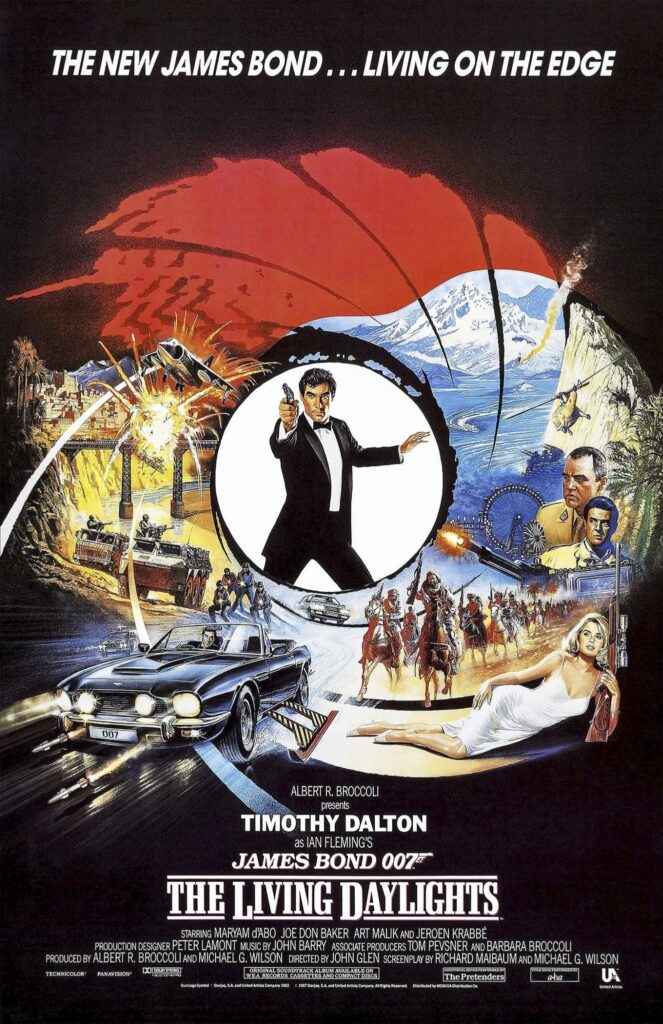
The narrative opens with a tense sniper exercise in Gibraltar that immediately establishes the film’s themes of restraint and judgment. When Bond chooses not to take a kill shot—suspecting something isn’t right—his decision reverberates through the story. That hesitation leads him to Kara Milovy, a gifted cellist entangled in a plot involving Soviet defection, arms trafficking, and a carefully constructed web of lies. From Vienna to Bratislava and onward to Afghanistan, the story unfolds as a layered spy thriller where appearances deceive and alliances shift with unnerving speed.
Timothy Dalton’s debut performance is the film’s defining strength. His Bond is intense, principled, and driven by a clear moral code. Gone is the smirk-first approach; Dalton plays Bond as a man burdened by duty and acutely aware of the cost of violence. This portrayal aligns closely with Ian Fleming’s literary version of the character—capable of tenderness, fierce loyalty, and cold resolve when necessary. Dalton’s Bond doesn’t relish danger; he endures it, making his victories feel earned rather than inevitable.
Maryam d’Abo’s Kara Milovy brings warmth and humanity to the story. As an artist rather than an operative, Kara represents innocence caught in the crossfire of espionage. Her evolving trust in Bond adds emotional texture, and their relationship develops through shared vulnerability rather than instant seduction. Kara’s presence underscores one of the film’s central ideas: the collateral damage intelligence games inflict on ordinary lives.
The antagonists in The Living Daylights reflect the era’s uncertainty. Jeroen Krabbé’s General Georgi Koskov initially appears as a classic defector but is soon revealed as a manipulative opportunist, while Joe Don Baker’s arms dealer Brad Whitaker embodies cynical profiteering. Together, they represent a world where ideology gives way to self-interest—a realistic evolution of Cold War villainy. The absence of a single, theatrical supervillain reinforces the film’s grounded tone.
Visually and kinetically, the film excels with practical stunts and location-driven action. A breathtaking cello case escape down a snow-covered mountainside, tense border crossings, and a rugged Afghan showdown emphasize physicality and danger over gadgetry. John Barry’s final Bond score blends urgency and romance, while the theme song “The Living Daylights” complements the film’s serious mood without overpowering it.
In its final act, the film resolves its conflicts through courage and integrity rather than spectacle. Bond exposes the conspiracy, protects the innocent, and chooses loyalty over convenience—decisions that define Dalton’s interpretation of the character. The ending feels resolute rather than triumphant, fitting a story rooted in realism.
Today, The Living Daylights is widely recognized as a successful reinvention that paved the way for a darker, more character-driven Bond. It reaffirmed the franchise’s ability to evolve with the times and reintroduced James Bond as a complex, morally grounded agent in a dangerous, ambiguous world—one where doing the right thing is rarely simple, but always necessary.
Did You Know:
- The Living Daylights was Timothy Dalton’s first appearance as James Bond, and his portrayal was intentionally modeled more closely on Ian Fleming’s original novels than previous films.
- Dalton was actually offered the role years earlier, but declined until the tone of the franchise shifted away from camp and toward realism.
- The dramatic cello case escape down a snow-covered mountainside was inspired by Fleming’s writing and became one of the film’s most iconic action sequences.
- Maryam d’Abo performed many of her own stunts, including physically demanding scenes during the escape and border-crossing sequences.
- The film marked the final James Bond score composed by John Barry, closing a defining musical chapter in the franchise’s history.
- The Afghanistan scenes were not filmed in Afghanistan; they were shot in Morocco to safely replicate the landscape.
- This is one of the few Bond films where Bond deliberately refuses to kill, reinforcing the character’s moral judgment and restraint.
- The title song “The Living Daylights” by a-ha was one of the first synth-driven Bond themes, signaling a modernized sound for the late 1980s.
- Joe Don Baker, who played villain Brad Whitaker, later returned to the franchise as CIA ally Jack Wade in the Pierce Brosnan era.
- Over time, the film has gained strong critical appreciation as one of the most faithful cinematic interpretations of Fleming’s Bond.
Licence to Kill (1989) — Timothy Dalton
Licence to Kill stands as one of the boldest and most radical departures in the history of the James Bond franchise. Released in 1989 as Timothy Dalton’s second and final outing as 007, the film strips away much of the traditional glamour and formality associated with Bond and replaces it with raw emotion, personal stakes, and unrelenting intensity. Licence to Kill is not a mission driven by government orders or global politics—it is a revenge story, fueled by loyalty, betrayal, and moral outrage.
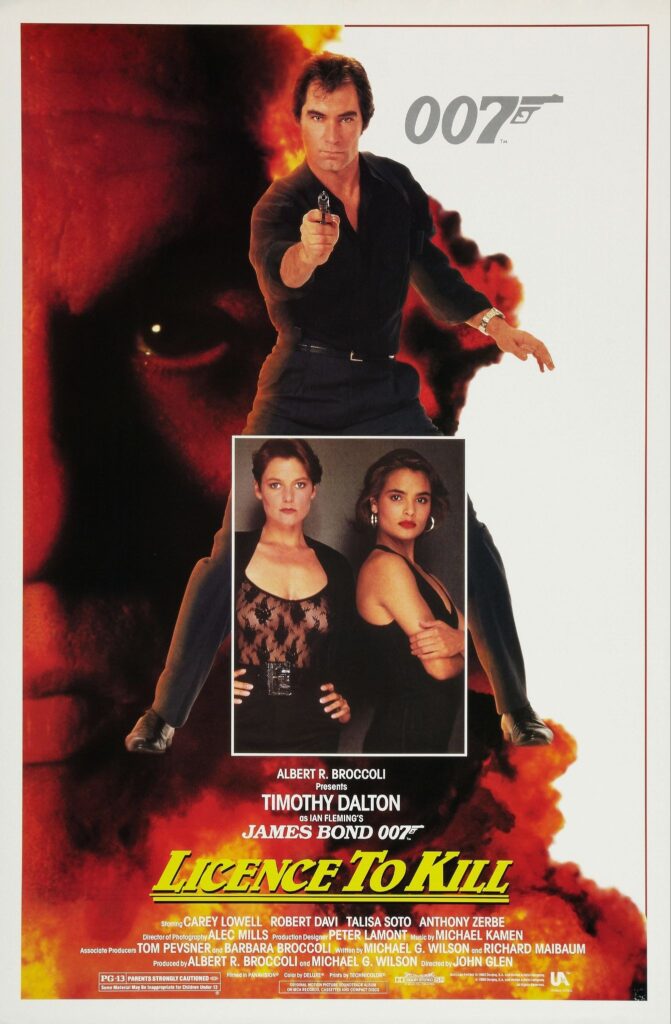
The film opens on a celebratory note with the wedding of Bond’s close friend and CIA ally Felix Leiter. What should be a moment of joy is violently shattered when drug lord Franz Sanchez captures Leiter and his wife, brutally maiming Felix and murdering his bride. This shocking act immediately redefines the tone of the film. Bond’s subsequent decision to pursue Sanchez outside official channels results in his dismissal from MI6, effectively turning him into a rogue agent. From this point forward, the story becomes intensely personal, redefining what it means for Bond to operate without the protection—or restraint—of authority.
Timothy Dalton delivers his most powerful performance as James Bond in this film. His portrayal is cold, focused, and deeply emotional, presenting Bond as a man driven by principle rather than protocol. Dalton’s Bond is relentless and uncompromising, willing to sacrifice reputation, career, and even survival in order to exact justice. This interpretation aligns closely with Ian Fleming’s darker literary vision of the character, emphasizing Bond’s capacity for obsession, pain, and moral absolutism.
Franz Sanchez, portrayed with chilling calm by Robert Davi, is one of the franchise’s most realistic and terrifying villains. Rather than a megalomaniac bent on world domination, Sanchez is a ruthless narcotics kingpin who values loyalty above all else—and punishes betrayal with horrific cruelty. His operation is grounded in psychological manipulation, fear, and control, making him feel disturbingly plausible. Bond’s strategy of dismantling Sanchez’s empire from within, turning lieutenants against one another, adds a layer of intelligence and patience that distinguishes this conflict from more straightforward showdowns.
The supporting cast plays a crucial role in reinforcing the film’s grounded tone. Carey Lowell’s Pam Bouvier is a capable, independent ally whose strength and loyalty make her one of the more grounded and credible Bond companions. Talisa Soto’s Lupe Lamora embodies moral conflict and vulnerability, trapped in a cycle of abuse and fear under Sanchez’s rule. Together, these characters highlight the human cost of power and violence in a world where survival often depends on allegiance.
Visually and stylistically, Licence to Kill embraces a gritty, late-1980s action aesthetic. Explosions are violent, stunts are physical, and the famous tanker-truck finale is one of the most dangerous and spectacular practical stunt sequences in the franchise. The lack of elaborate gadgets and flamboyant set pieces reinforces the film’s realism, keeping the focus squarely on character and consequence rather than spectacle.
Musically, Michael Kamen’s score supports the film’s darker atmosphere, while the title song “Licence to Kill” carries a somber, almost mournful tone that reflects Bond’s emotional state. The soundtrack avoids excess, mirroring the film’s restrained but intense storytelling.
In its conclusion, Licence to Kill offers resolution rather than triumph. Bond succeeds, but the victory feels costly and sobering. The film closes with a sense of earned closure, emphasizing that justice has been served, but innocence cannot be restored. There is no celebration—only survival and reckoning.
Today, Licence to Kill is often viewed as a precursor to the darker, more character-driven Bond films that would emerge decades later, particularly during the Daniel Craig era. While controversial at the time of release, it has since gained critical appreciation as one of the franchise’s most courageous experiments. By daring to portray James Bond not as a symbol, but as a man pushed to his limits, Licence to Kill redefined what a Bond film could be—and proved that even 007 can bleed when loyalty is broken.
Did You Know:
- Licence to Kill was the first Bond film not to use the word “die” in its title in the U.S., as studios worried the original title (Licence Revoked) sounded too bleak.
- Timothy Dalton’s portrayal is considered the closest cinematic interpretation of Ian Fleming’s literary Bond, emphasizing ruthlessness, loyalty, and emotional consequence.
- The film was heavily influenced by 1980s crime thrillers, shifting Bond closer to movies like Miami Vice than traditional espionage adventures.
- Robert Davi’s villain Franz Sanchez was inspired by real-life drug lords, making him one of the most realistic and unsettling antagonists in the franchise.
- The brutal attack on Felix Leiter was directly adapted from Fleming’s novel Live and Let Die, though placed in a completely different story context.
- This is one of the few Bond films where 007 is officially disavowed by MI6, operating entirely as a rogue agent.
- The explosive tanker-truck finale was performed with real vehicles and practical effects, making it one of the most dangerous stunt sequences of the era.
- Carey Lowell’s Pam Bouvier was written as a fully capable field operative, reflecting a shift toward more independent Bond women.
- The film received a PG-13 rating in the U.S., but was widely considered one of the most violent Bond entries up to that point.
- Though divisive on release, Licence to Kill is now often praised as a precursor to the darker Daniel Craig–era Bond films.
GoldenEye (1995) — Pierce Brosnan
GoldenEye represents one of the most important reinventions in the history of the James Bond franchise. Released after a six-year hiatus following Licence to Kill, the film had the daunting task of reintroducing 007 to a post–Cold War world while proving the character was still relevant in a rapidly changing cinematic landscape. GoldenEye succeeds decisively, launching Pierce Brosnan as James Bond and ushering the franchise into the modern blockbuster era with confidence, sophistication, and renewed energy.
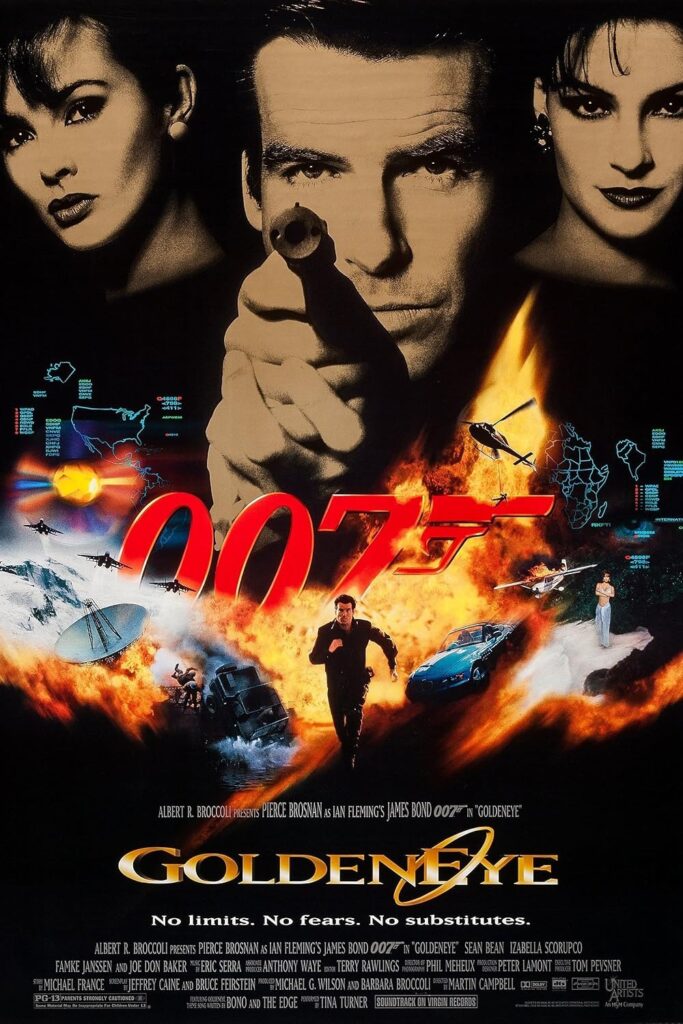
The film opens with a striking pre-title sequence set in 1986, where Bond and fellow agent Alec Trevelyan infiltrate a Soviet chemical weapons facility. This mission establishes the film’s emotional foundation, ending in betrayal and apparent loss that will echo throughout the story. Years later, Bond is assigned to investigate the use of the GoldenEye weapon—a space-based electromagnetic pulse satellite capable of disabling all electronic systems over a vast area. What initially appears to be a rogue-state threat soon reveals itself as something far more personal, tying Bond’s past directly to the present danger.
Pierce Brosnan’s debut as Bond strikes a near-perfect balance between classic charm and contemporary edge. He combines Sean Connery’s authority, Roger Moore’s wit, and Timothy Dalton’s intensity into a cohesive and confident portrayal. Brosnan’s Bond is polished but dangerous, emotionally guarded yet capable of moral reflection. Importantly, the film allows Bond to be questioned—by allies, adversaries, and even himself—about his relevance in a world no longer defined by clear ideological enemies.
The villain of GoldenEye is one of the most compelling in the series. Sean Bean’s Alec Trevelyan, revealed as the mastermind behind the GoldenEye plot, is a former agent driven by betrayal and historical grievance. As a rogue “00” agent, Trevelyan serves as Bond’s dark mirror—someone who shares his skills and background but has chosen revenge over duty. Their conflict is deeply personal, elevating the stakes beyond global destruction to a clash of identity, loyalty, and legacy.
Izabella Scorupco’s Natalya Simonova brings intelligence, resilience, and emotional depth to the film. As a survivor of the GoldenEye attack, Natalya is not merely a companion but a crucial participant in stopping Trevelyan’s plan. Her skepticism of Bond’s profession and insistence on accountability reflect the film’s broader themes, challenging the morality of espionage in a world shaped by its consequences.
Visually, GoldenEye is bold and kinetic. From the iconic bungee jump opening to tank chases through the streets of St. Petersburg and the climactic showdown atop a massive satellite dish, the film delivers memorable set pieces grounded in practical effects and real locations. Eric Serra’s unconventional score gives the film a distinctive 1990s sound, underscoring its break from the past while reinforcing its modern identity.
The supporting cast further strengthens the film’s impact. Judi Dench’s debut as M introduces a sharper, more authoritative presence who openly challenges Bond’s methods, labeling him a “relic of the Cold War.” This dynamic adds intellectual weight and sets the tone for future films. Meanwhile, the reimagined Q and Moneypenny maintain continuity while adapting to a changing world.
In its final act, GoldenEye delivers a powerful confrontation that is both physical and ideological. Bond’s victory is hard-fought and personal, reinforcing the film’s central message: survival in a new world requires adaptation, not nostalgia. The destruction of the GoldenEye weapon symbolizes the end of old conflicts and the uncertain beginning of a new era.
Today, GoldenEye is widely regarded as one of the franchise’s strongest entries and one of the greatest Bond films ever made. It successfully revived James Bond for a new generation, proving that the character could evolve without losing his essence. With its blend of action, character depth, and modern relevance, GoldenEye stands as a masterclass in franchise reinvention—and a defining moment for 007’s enduring legacy.
Did You Know:
- GoldenEye marked Pierce Brosnan’s first appearance as James Bond, a role he had originally been considered for nearly a decade earlier before scheduling conflicts intervened.
- The famous bungee jump opening stunt was performed for real and is often ranked as one of the greatest pre-title sequences in Bond history.
- Sean Bean’s villain, Alec Trevelyan (006), is one of the few Bond antagonists to be a former “00” agent, making him a true equal and mirror to Bond.
- Judi Dench made her debut as M, becoming the first woman to hold the role and famously calling Bond a “sexist, misogynist dinosaur.”
- The massive satellite dish finale was filmed at Arecibo Observatory in Puerto Rico, which had never been used for a Bond climax before.
- The tank chase through St. Petersburg used a real tank and practical effects rather than CGI, contributing to its lasting impact.
- Composer Eric Serra’s electronic-heavy score was controversial among fans but intentionally chosen to modernize the franchise’s sound.
- The character of Natalya Simonova was written as a computer programmer and survivor, reflecting the growing importance of technology in the post–Cold War era.
- GoldenEye was the first Bond film released after the end of the Cold War, forcing the franchise to redefine its geopolitical relevance.
- The movie’s success effectively saved the Bond franchise after a six-year hiatus and paved the way for the modern blockbuster Bond era.
Tomorrow Never Dies (1997) — Pierce Brosnan
Tomorrow Never Dies is a fast-paced, sharply topical entry in the James Bond franchise that doubles down on modern relevance. As Pierce Brosnan’s second outing as 007, the film pivots from post–Cold War reckoning to a new kind of global threat: the manipulation of information itself. Released in 1997—on the cusp of the 24-hour news cycle and the internet age—the movie feels prescient, transforming media power into a weapon as dangerous as any missile.
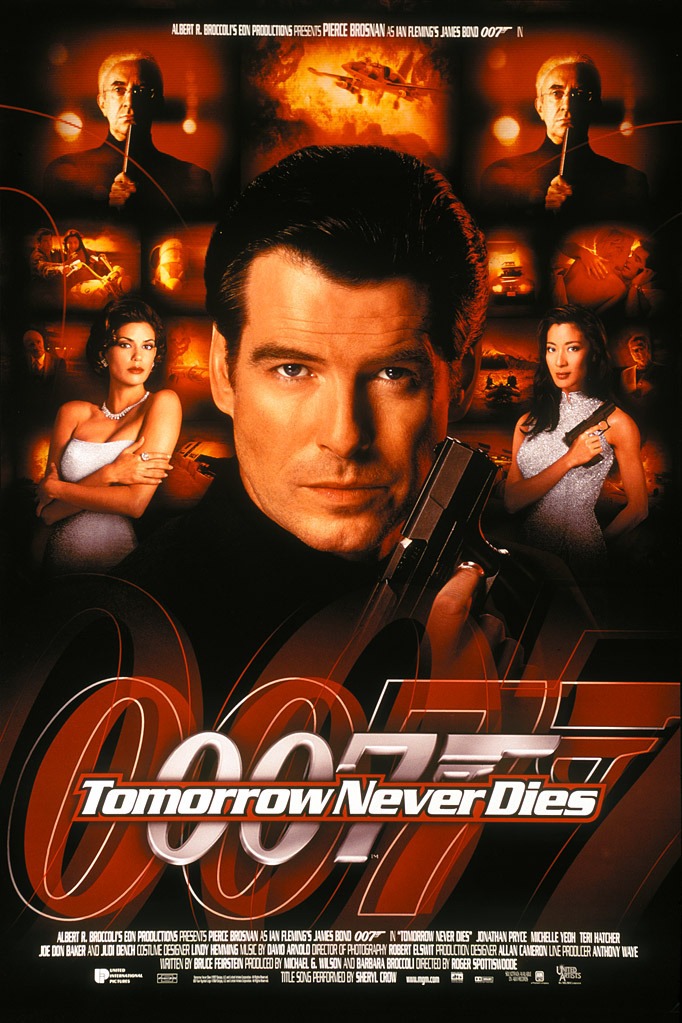
The plot ignites when a British warship is mysteriously sunk in the South China Sea, threatening to trigger open conflict between major powers. Bond is assigned to investigate media mogul Elliot Carver, whose news empire seems uncannily prepared to profit from every unfolding crisis. As Bond peels back the layers, he discovers a meticulously engineered scheme designed to provoke war so Carver can secure exclusive broadcast rights and dominate global media. The story smartly frames chaos as content, turning headlines into leverage and truth into a casualty.
Pierce Brosnan’s Bond is confident, kinetic, and fully settled into the role. He blends classic polish with modern urgency, navigating action set pieces with ease while remaining alert to the moral rot beneath the spectacle. This Bond is decisive and physically capable, yet increasingly aware that enemies no longer need armies to change the world—just airtime. Brosnan’s performance anchors the film’s momentum, keeping its high-speed action grounded in character.
Jonathan Pryce delivers a deliciously unsettling performance as Elliot Carver, one of the franchise’s most distinctive villains. Modeled loosely on real-world media tycoons, Carver is vain, volatile, and obsessed with control—not through conquest, but through narrative. His mania for influence, ratings, and recognition makes him a uniquely modern antagonist, and his smug certainty that he can shape reality through coverage alone gives the film its sharpest edge.
Michelle Yeoh’s Wai Lin is a standout addition to the Bond canon. As a Chinese intelligence operative, she is Bond’s equal in skill, intelligence, and resolve, often rescuing him as much as he rescues her. Their partnership is built on mutual respect and professional alignment rather than instant romance, refreshing the dynamic and giving the film a contemporary sensibility. Yeoh’s physicality and presence elevate every scene she’s in.
Visually, Tomorrow Never Dies is relentless and muscular. The action sequences—especially the motorcycle chase through Saigon, the remote-controlled BMW pursuit, and the assault on Carver’s stealth ship—are tightly choreographed and inventive. The stealth ship itself, invisible to radar and bristling with firepower, reflects the film’s central theme: unseen forces reshaping the world while the public watches a curated version of events.
David Arnold’s score injects energy and modern flair while honoring Bond’s musical heritage, and the title song underscores the film’s obsession with headlines and immediacy. The pacing rarely lets up, mirroring the nonstop churn of news that the story critiques. Even quieter moments feel charged, as if the next breaking alert is seconds away.
In its climax, Tomorrow Never Dies brings spectacle and theme into alignment. Bond and Wai Lin dismantle Carver’s operation not just by stopping a weapon, but by exposing a lie—asserting that truth, however fragile, still matters. The resolution reinforces the film’s warning: when information becomes a commodity, the cost is measured in lives.
Today, Tomorrow Never Dies is often reassessed as one of the most forward-looking Bond films. Its satire of media manipulation, manufactured outrage, and profit-driven conflict feels even more relevant decades later. As a high-octane thriller with a sharp thematic bite, it proves that James Bond can adapt to new threats without losing his edge—because in a world where tomorrow’s news can start a war, 007 is still the last line of defense.
Did You Know:
- The film’s villain, Elliot Carver, was inspired by real-world media moguls, and his obsession with controlling the news is often cited as eerily prophetic in today’s media landscape.
- The original title song was intended to be “Tomorrow Never Lies,” reflecting the theme of media deception, but a spelling error reportedly led to the final title, Tomorrow Never Dies.
- Michelle Yeoh performed many of her own stunts, including complex fight choreography, helping redefine the Bond woman as a true action equal.
- The remote-controlled BMW 750i chase was filmed with Pierce Brosnan operating the car using a hidden phone interface, a gadget concept far ahead of its time.
- Jonathan Pryce deliberately modeled Carver with exaggerated theatricality, making him one of the most animated and talkative Bond villains.
- The massive stealth ship set was one of the largest ever constructed for a Bond film and required extensive mechanical effects rather than CGI.
- This was the first Bond film scored by David Arnold, beginning a musical run that would define the franchise well into the Daniel Craig era.
- The motorcycle chase scene in Saigon, with Bond and Wai Lin handcuffed together, is considered one of the most technically complex stunt sequences of the 1990s.
- The film was released just as 24-hour news networks were expanding globally, making its themes feel immediately relevant to contemporary audiences.
The World Is Not Enough (1999) — Pierce Brosnan
The World Is Not Enough is one of the most character-driven and emotionally layered entries of the Pierce Brosnan era, pushing the James Bond franchise into darker psychological territory while retaining its trademark spectacle. Released in 1999, the film explores themes of betrayal, pain, and manipulation, presenting a story where the most dangerous weapon is not technology or firepower, but emotional control. In many ways, it serves as the Brosnan era’s most ambitious attempt to humanize Bond while still delivering blockbuster thrills.
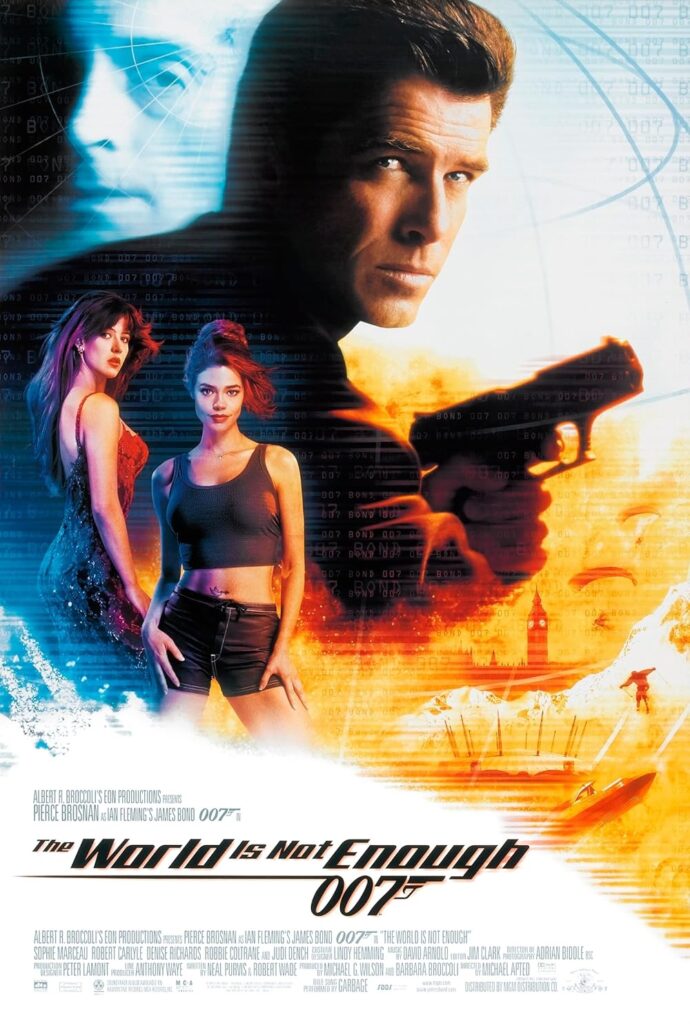
The film opens with a high-energy pre-title sequence on the River Thames, where Bond races to recover stolen money tied to the murder of oil tycoon Sir Robert King. This kinetic opening—culminating near London’s Millennium Dome—immediately establishes momentum and stakes. Bond is soon assigned to protect King’s daughter, Elektra King, who has inherited her father’s vast oil empire and is believed to be the target of a revenge-driven terrorist plot. What appears to be a standard protection detail quickly evolves into something far more complex and dangerous.
Pierce Brosnan delivers one of his most nuanced performances as Bond in this film. His 007 is confident and capable, but noticeably more vulnerable. Bond allows himself to grow emotionally close to Elektra, blurring the line between professional duty and personal attachment. This choice proves costly and marks one of the rare times in the franchise where Bond’s emotional instincts are used against him. Brosnan balances charm and introspection, showing a Bond who can be seduced not just physically, but psychologically.
Sophie Marceau’s Elektra King is one of the most fascinating characters in Bond history. Initially portrayed as a victim—soft-spoken, traumatized, and sympathetic—Elektra gradually reveals herself as the true mastermind of the film. Her manipulation of Bond, her calculated cruelty, and her willingness to orchestrate mass destruction make her one of the franchise’s most complex and effective villains. Elektra represents a rare inversion of the Bond formula: the love interest who is actually the primary antagonist.
Robert Carlyle’s Renard complements Elektra as a physically imposing but emotionally hollow enforcer. Unable to feel pain due to a bullet lodged in his brain, Renard is less a traditional villain than a tragic weapon shaped by Elektra’s influence. His lack of sensation mirrors the emotional numbness that defines the film’s darker tone. Together, Elektra and Renard form a villainous partnership rooted not in ideology, but obsession and control.
The plot unfolds across a range of striking international locations, including Azerbaijan, the Caspian Sea, and Istanbul. The central conflict revolves around control of oil pipelines and nuclear material, grounding the film in late-1990s geopolitical anxieties. The action sequences—such as the ski chase, submarine showdown, and underground reactor finale—are large in scale but always tied to character motivations rather than pure spectacle.
The supporting cast adds depth and continuity. Judi Dench’s M plays a more personal role in this story, having had a long-standing relationship with Elektra’s father. This connection brings M into the emotional crossfire and allows the film to explore the cost of leadership and misplaced trust. Denise Richards’s Dr. Christmas Jones provides scientific expertise and levity, though her presence has remained one of the film’s most debated elements among fans.
Musically, David Arnold’s score builds on the momentum of Tomorrow Never Dies, blending classic Bond themes with darker, more introspective motifs. The title song, “The World Is Not Enough,” reinforces the film’s central idea: power and wealth are never sufficient when driven by obsession.
In its final act, the film delivers one of the franchise’s most emotionally decisive moments, forcing Bond to confront betrayal head-on. His resolution is swift, controlled, and deeply personal, underscoring the film’s message that sentimentality can be fatal in the world of espionage.
Today, The World Is Not Enough is often reappraised as one of the most thematically mature Bond films of its era. While not without flaws, its willingness to center the story on emotional manipulation and moral consequence sets it apart from more straightforward entries. It stands as a reminder that in James Bond’s world, the greatest threats are not always external—and that sometimes, the most dangerous enemy is the one who earns your trust.
Did You Know:
- This film is the first (and so far only) Bond movie where the primary villain is a Bond girl, with Sophie Marceau’s Elektra King subverting the franchise’s usual formula.
- The title The World Is Not Enough comes from the Bond family coat of arms (motto: Orbis non sufficit), making it deeply personal to the character’s mythology.
- The opening boat chase on the River Thames is one of the longest and most expensive pre-title sequences ever filmed for a Bond movie.
- Robert Carlyle’s character Renard cannot feel pain due to a bullet in his brain, making him one of the most physically dangerous yet emotionally empty villains in the series.
- Judi Dench’s M plays a more emotionally involved role than ever before, with her past decisions directly contributing to the film’s central conflict.
- Pierce Brosnan has said this was one of the films where Bond’s emotional vulnerability is most clearly on display.
- The Millennium Dome (now The O2 Arena) was newly constructed at the time, making the opening sequence a showcase of modern London.
- Denise Richards was only 25 years old during filming, and her casting as nuclear physicist Christmas Jones sparked significant debate among fans.
- The film includes multiple fake pipeline and reactor sets, as filming near real nuclear facilities was prohibited.
- Over time, the movie has gained appreciation for its strong villain writing, particularly Elektra King’s manipulation of Bond.
Die Another Day (2002) — Pierce Brosnan
Die Another Day is the most extravagant and divisive entry of the Pierce Brosnan era, designed as both a celebration of the franchise’s 40th anniversary and a maximalist showcase of early-2000s blockbuster excess. Released in 2002, the film leans unapologetically into spectacle, technology, and heightened fantasy, pushing the Bond formula to its outer limits. It’s a movie that wears its ambition on its sleeve—sometimes thrilling, sometimes overwhelming—capturing a franchise at the peak of its pre-reboot confidence.
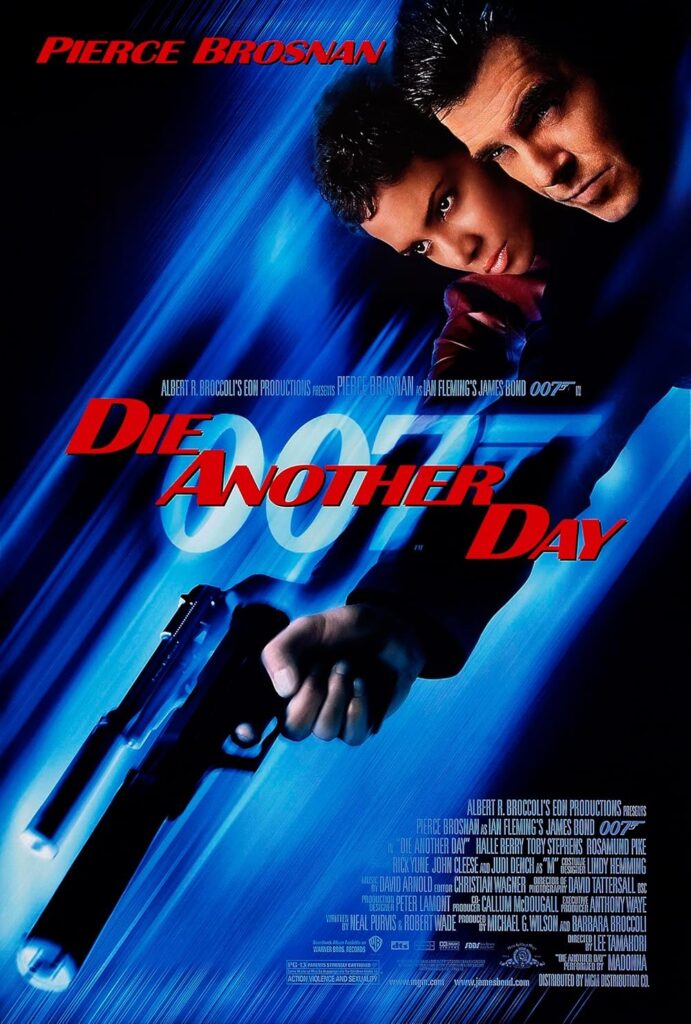
The story opens with a striking departure from tradition. Bond is captured during a mission in North Korea, tortured, and imprisoned for over a year before being released in a controversial prisoner exchange. This opening act promises a darker, more introspective Bond, one forced to confront betrayal, physical trauma, and suspicion from his own government. Although the film later pivots toward extravagance, these early moments establish unusually high personal stakes and hint at a version of Bond pushed closer to the edge than usual.
As Bond follows the trail from Cuba to Iceland, the narrative transforms into a high-concept thriller centered on identity, reinvention, and technological power. He uncovers a plot involving Gustav Graves, a flamboyant diamond magnate whose public persona masks a far more dangerous truth. Graves’ plan hinges on the Icarus satellite, a space-based solar weapon capable of reshaping geopolitical borders through devastating precision strikes. The film blends Cold War remnants with futuristic ambition, using science fiction concepts to escalate the threat to global proportions.
Pierce Brosnan delivers his final performance as James Bond with polished confidence and physical authority. This version of Bond is sleek, battle-hardened, and resolutely unflappable, even as the world around him grows increasingly fantastical. Brosnan balances moments of bitterness and resolve with trademark charm, embodying a Bond who has survived betrayal and captivity without losing his sense of control. It is a fitting swan song for his interpretation—self-assured, stylish, and larger than life.
The film’s villains reflect its taste for excess. Toby Stephens’ Gustav Graves is theatrical, arrogant, and obsessed with transformation, while Rosamund Pike’s Miranda Frost adds deception and double-crossing to the mix. Their ice-palace stronghold in Iceland epitomizes the film’s visual ambition—cold, reflective, and deliberately artificial. The antagonists feel less grounded than earlier Brosnan-era villains, reinforcing the sense that Die Another Day exists in a heightened, almost comic-book version of the Bond universe.
Halle Berry’s Jinx Johnson stands out as one of the film’s most enduring elements. Introduced in a deliberate visual homage to Dr. No, Jinx is confident, capable, and action-oriented, operating as a near-equal to Bond rather than a traditional romantic counterpart. Berry’s performance injects energy and presence into the film, and her chemistry with Brosnan underscores the movie’s celebratory tone.
Visually, Die Another Day is packed with iconic imagery and ambitious set pieces: sword fights in a London fencing club, a CGI-heavy ice chase between high-tech vehicles, and the debut of the Aston Martin Vanquish with adaptive camouflage. The reliance on early-2000s digital effects marks the film as a product of its time, contributing both to its spectacle and to the criticism it would later receive. David Arnold’s score and Madonna’s bold, electronic title song reinforce the film’s modern, aggressive aesthetic.
In its final act, the movie abandons restraint in favor of all-out escalation, delivering airborne combat, collapsing structures, and last-second heroics. The resolution is triumphant and theatrical, emphasizing Bond as an indestructible force rather than a conflicted man. It’s a conclusion that feels intentionally operatic—closing not just a mission, but an era.
Today, Die Another Day is often viewed as the endpoint of the classic Bond formula before its dramatic reinvention with Casino Royale. While criticized for excess, it remains a fascinating snapshot of where the franchise stood at the turn of the millennium: confident, experimental, and unafraid to go big. As Pierce Brosnan’s farewell, it stands as a glossy, bombastic celebration of 007—one that ultimately proved the series needed reinvention, even as it reminded audiences why James Bond had endured for forty years.
Did You Know:
- Die Another Day was released to celebrate the 40th anniversary of the James Bond film franchise, and it intentionally includes numerous callbacks to earlier Bond movies.
- Pierce Brosnan has said this film pushed Bond “as far as he could go” in terms of gadgets and spectacle, directly influencing the franchise’s later reboot.
- Halle Berry’s beach entrance was a deliberate homage to Ursula Andress in Dr. No, recreated as a modern anniversary tribute.
- The invisible Aston Martin Vanquish became one of the most controversial gadgets in Bond history, symbolizing the franchise’s turn toward sci-fi excess.
- The ice-chase sequence heavily relied on early CGI, which has since dated the film more than most Bond entries.
- Madonna not only performed the title song but also appeared on screen as a fencing instructor—making her one of the few theme artists to cameo in a Bond film.
- Toby Stephens (Gustav Graves) is the son of Maggie Smith, though many viewers were unaware at the time of release.
- The opening sequence, where Bond is captured and tortured, was the darkest beginning of a Brosnan-era Bond film.
- This was Pierce Brosnan’s final appearance as James Bond, closing an era defined by sleek style and blockbuster scale.
- The film’s mixed reception directly contributed to the decision to reboot the franchise with Casino Royale in 2006.
Casino Royale (2006) — Daniel Craig
Casino Royale represents one of the most significant reinventions in the history of the James Bond franchise. Released in 2006, the film rebooted 007 from the ground up, discarding decades of accumulated continuity to reintroduce Bond at the very beginning of his career. With Daniel Craig stepping into the role, Casino Royale abandons excess and invincibility in favor of raw physicality, emotional consequence, and psychological realism. It is a bold recalibration that redefines not just who Bond is, but why he becomes who he is.
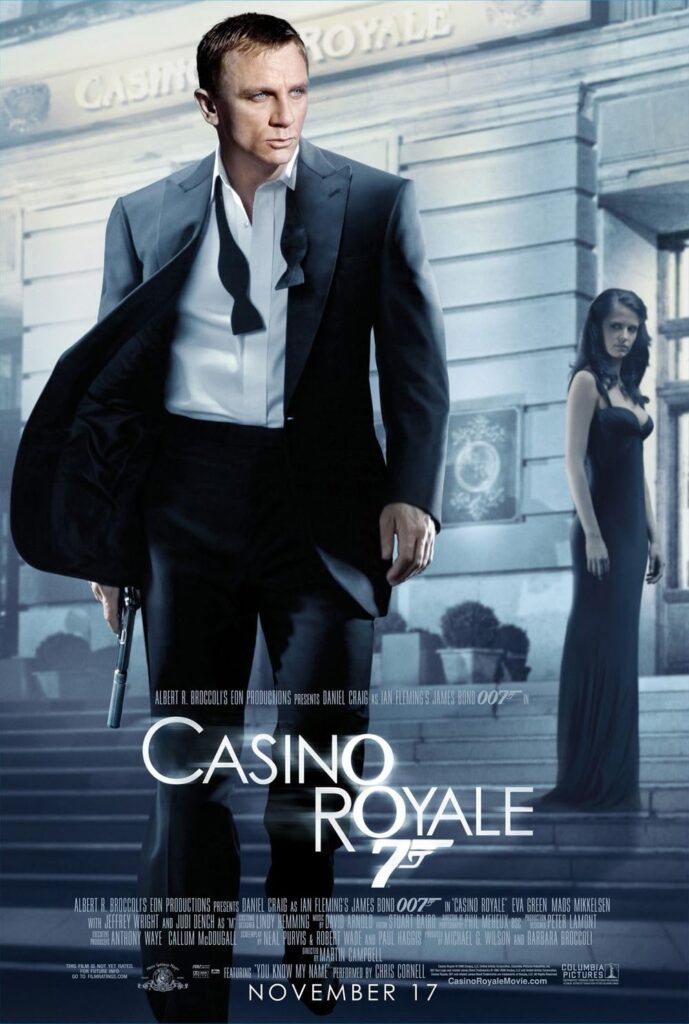
The story follows Bond immediately after earning his “00” status, marking him as newly licensed to kill but still rough around the edges. His first mission leads him to Le Chiffre, a shadowy financier who bankrolls terrorist organizations and criminal syndicates. When Le Chiffre loses his clients’ money, Bond is sent to defeat him in a high-stakes poker game at Casino Royale in Montenegro, forcing the villain into exposure and capture. What might have been a simple gambling plot becomes a test of endurance, discipline, and judgment, revealing that intelligence work is as much about emotional control as physical survival.
Daniel Craig’s portrayal is a radical departure from previous Bonds. His Bond is blunt, dangerous, and visibly fallible—more brawler than gentleman in his early moments. Craig emphasizes Bond’s inexperience, impatience, and volatility, portraying a man still learning the cost of violence and the weight of responsibility. As the film progresses, Bond evolves from a weapon into an operative with restraint and awareness, making his transformation central to the narrative rather than assumed.
Eva Green’s Vesper Lynd is the emotional heart of the film and one of the most complex characters the franchise has ever produced. Intelligent, guarded, and morally conflicted, Vesper challenges Bond intellectually and emotionally from their first encounter. Their relationship develops gradually, grounded in mutual respect and vulnerability rather than formulaic seduction. Vesper is not simply a love interest—she is a catalyst, shaping Bond’s worldview and permanently altering his emotional landscape.
Mads Mikkelsen’s Le Chiffre is a chillingly grounded antagonist. Unlike grandiose villains seeking domination, Le Chiffre is motivated by desperation, greed, and fear. His bleeding eye, nervous demeanor, and reliance on others’ power make him unsettlingly human. He is not in control of the world—he is trapped by it. This realism elevates the conflict, framing Bond’s mission as a battle against modern financial terror networks rather than theatrical evil.
Visually and tonally, Casino Royale is stripped down and intense. Action scenes are brutal and physical, from the parkour chase in Madagascar to the infamous torture sequence that tests Bond’s resolve in harrowing fashion. These moments emphasize pain and consequence, rejecting the fantasy that Bond can survive without cost. David Arnold’s score supports this grounded approach, while the theme song “You Know My Name” announces a Bond who must earn his identity rather than inherit it.
The film’s final act delivers one of the most emotionally devastating conclusions in the franchise. Bond believes he has won—professionally and personally—only to face betrayal and loss that crystallize his emotional armor. The closing moments show Bond completing his transformation, not through triumph, but through heartbreak. The man who emerges is colder, sharper, and more guarded, setting the foundation for the Bond audiences recognize.
Today, Casino Royale is widely regarded as one of the greatest James Bond films ever made. It successfully modernized the franchise without sacrificing its essence, proving that reinvention could coexist with tradition. By grounding Bond in humanity, vulnerability, and consequence, Casino Royale didn’t just restart the series—it gave it renewed purpose, ensuring that 007 could thrive in a world where invincibility was no longer believable, but resilience still was.
Did You Know:
- Casino Royale was a full reboot of the Bond franchise, ignoring continuity from earlier films and restarting Bond’s story from his first “00” kills.
- Daniel Craig was initially controversial casting, with some fans doubting his blond hair and rugged look—criticism that largely vanished after the film’s release.
- The parkour chase sequence at the beginning was one of the first major uses of parkour in a Hollywood blockbuster, influencing action films that followed.
- Eva Green’s Vesper Lynd is often ranked as one of the greatest Bond girls of all time, praised for her emotional depth and narrative importance.
- The poker game was changed from baccarat in the novel to Texas Hold ’Em, reflecting modern gambling trends and making the stakes more accessible to audiences.
- Mads Mikkelsen’s villain Le Chiffre bleeds from his eye as a visual metaphor for stress and fear, emphasizing his vulnerability rather than dominance.
- The brutal torture scene was adapted directly from Ian Fleming’s 1953 novel, making it one of the most faithful moments in the franchise.
- The famous line “Bond, James Bond” is deliberately withheld until the final scene, symbolizing Bond fully earning his identity.
- This was the first Bond film to use a title song over the end credits instead of the opening, reinforcing the film’s unconventional structure.
- Casino Royale is widely credited with saving and modernizing the franchise, paving the way for darker, character-driven Bond films in the Daniel Craig era.
Quantum of Solace (2008) — Daniel Craig
Quantum of Solace is the most direct continuation in the history of the James Bond franchise, picking up moments after the emotional devastation of Casino Royale. Rather than offering a standalone adventure, the film functions as a second chapter in Bond’s origin story, exploring the psychological fallout of betrayal, loss, and unresolved grief. Released in 2008, Quantum of Solace doubles down on the darker, more grounded tone introduced by Daniel Craig, presenting a Bond who is wounded, angry, and dangerously close to losing himself.
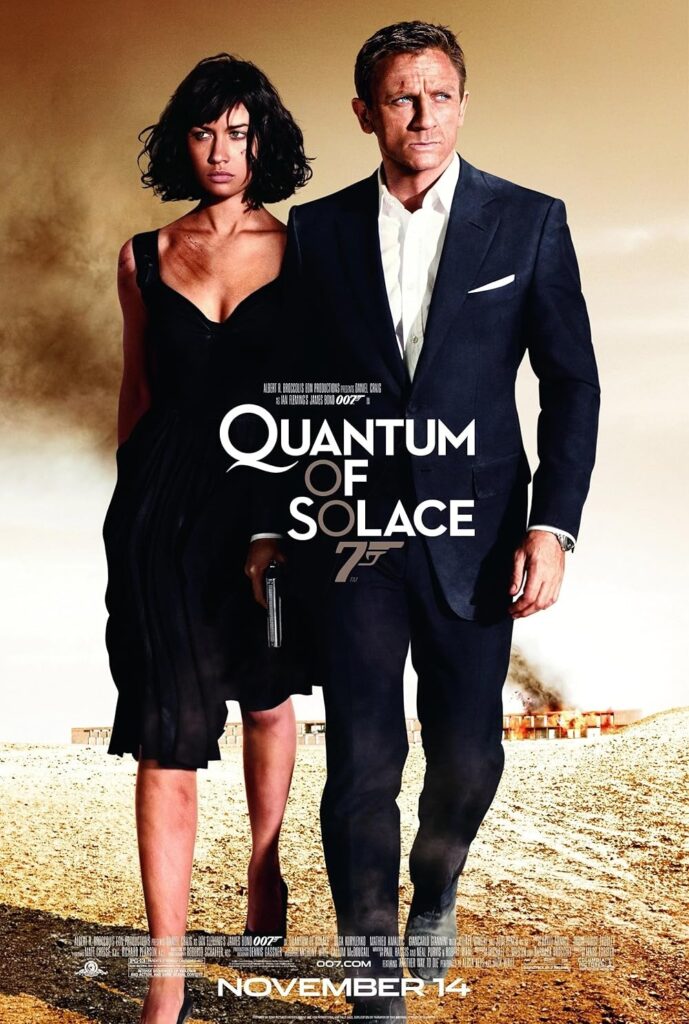
The story opens with Bond fleeing Italy with Mr. White in custody, immediately plunging the audience into a relentless pursuit that mirrors Bond’s internal state. As Bond interrogates White, he uncovers the existence of Quantum, a shadowy global organization embedded within governments, corporations, and intelligence agencies. This revelation reframes the events of Casino Royale, expanding the scope of Bond’s enemy from a single financier to a vast, invisible network manipulating world events for profit and control.
Daniel Craig’s Bond is raw and emotionally volatile throughout the film. Unlike previous iterations of the character, this Bond is driven less by duty than by obsession. Craig portrays a man struggling to reconcile his grief over Vesper Lynd with the demands of his profession, often acting with brutal efficiency and reckless disregard for protocol. His arc centers on whether he will allow vengeance to define him—or whether he can reclaim the discipline that separates an agent from a killer.
The primary antagonist, Dominic Greene—played by Mathieu Amalric—is a deliberate departure from traditional Bond villains. Greene is not physically imposing or theatrically evil; instead, he is manipulative, cowardly, and disturbingly plausible. As a senior member of Quantum, Greene orchestrates a plan to control Bolivia’s water supply, using environmental reform as a façade for economic domination. His understated menace reflects the film’s broader theme: modern power is exercised quietly, through contracts, resources, and influence rather than spectacle.
Olga Kurylenko’s Camille Montes provides a powerful parallel to Bond’s emotional journey. Like Bond, Camille is driven by revenge, haunted by childhood trauma and determined to confront the man responsible for her family’s murder. Their relationship is notably restrained—defined by mutual understanding rather than romance. Camille serves as a mirror to Bond, allowing the film to explore two paths of vengeance and the possibility of closure without emotional entanglement.
Visually, Quantum of Solace is aggressive and kinetic. The action sequences are fast, fragmented, and deliberately disorienting, reflecting Bond’s fractured mental state. Set pieces span Siena, Haiti, Austria, and the Bolivian desert, culminating in a stark showdown at an eco-hotel in the desert—a location that symbolically strips away glamour in favor of exposure and reckoning. David Arnold’s score reinforces the tension with urgent rhythms and restrained motifs, while the theme song “Another Way to Die” underscores the film’s confrontational energy.
The role of M, portrayed by Judi Dench, is particularly significant in this installment. M acts as both authority figure and moral anchor, repeatedly confronting Bond about his behavior while quietly protecting him from institutional fallout. Their dynamic emphasizes the film’s central question: can Bond remain effective without losing his humanity? The answer unfolds gradually through Bond’s choices rather than explicit dialogue.
In its final moments, Quantum of Solace delivers a subdued but meaningful resolution. Bond’s confrontation with the truth about Vesper allows him to let go of the anger that has driven him, completing the emotional arc begun in Casino Royale. There is no triumphant celebration—only acceptance and restraint.
Today, Quantum of Solace is often reassessed as a misunderstood but essential chapter in the Daniel Craig era. While its pacing and stylistic choices divided audiences on release, its thematic focus on grief, accountability, and the cost of vengeance gives it lasting weight. Rather than offering comfort or spectacle, the film provides exactly what its title promises: a measure of solace—not through revenge, but through release.
Did You Know:
- Quantum of Solace is the only Bond film that begins immediately after the previous one, picking up minutes after the ending of Casino Royale.
- The title comes from an Ian Fleming short story, though the plot itself is entirely original and not a direct adaptation.
- The film was heavily affected by the 2007–2008 Writers Guild of America strike, which led director Marc Forster and Daniel Craig to rewrite scenes during production.
- Daniel Craig has said this was the most physically demanding Bond film he made, due to the relentless pacing and close-quarters combat.
- The villain Dominic Greene was designed to be intentionally unimpressive physically, reflecting modern threats rooted in corporations and resource control rather than brute force.
- Olga Kurylenko’s Camille Montes is one of the few Bond women who does not have a romantic relationship with Bond, emphasizing shared trauma instead of attraction.
- The famous opera scene in Austria features real opera performers, with Quantum members revealed through subtle earpiece use rather than overt exposition.
- The Bolivian desert hotel finale was filmed in Panama, not Bolivia, due to logistical and safety concerns.
- The theme song “Another Way to Die” was the first Bond theme performed as a duet and remains one of the franchise’s most stylistically divisive.
- While controversial on release, the film is now often seen as a necessary emotional bridge between Casino Royale and Skyfall.
Skyfall (2012) — Daniel Craig
Skyfall is widely regarded as one of the most accomplished and emotionally resonant entries in the James Bond franchise, redefining 007 not through reinvention, but through reflection. Released in 2012 to mark the series’ 50th anniversary, Skyfall looks backward as much as it looks forward—interrogating Bond’s relevance, loyalty, and identity in a modern world that questions the value of old institutions. It is a film about legacy, trust, and the personal cost of service, wrapped in some of the most elegant filmmaking the series has ever produced.
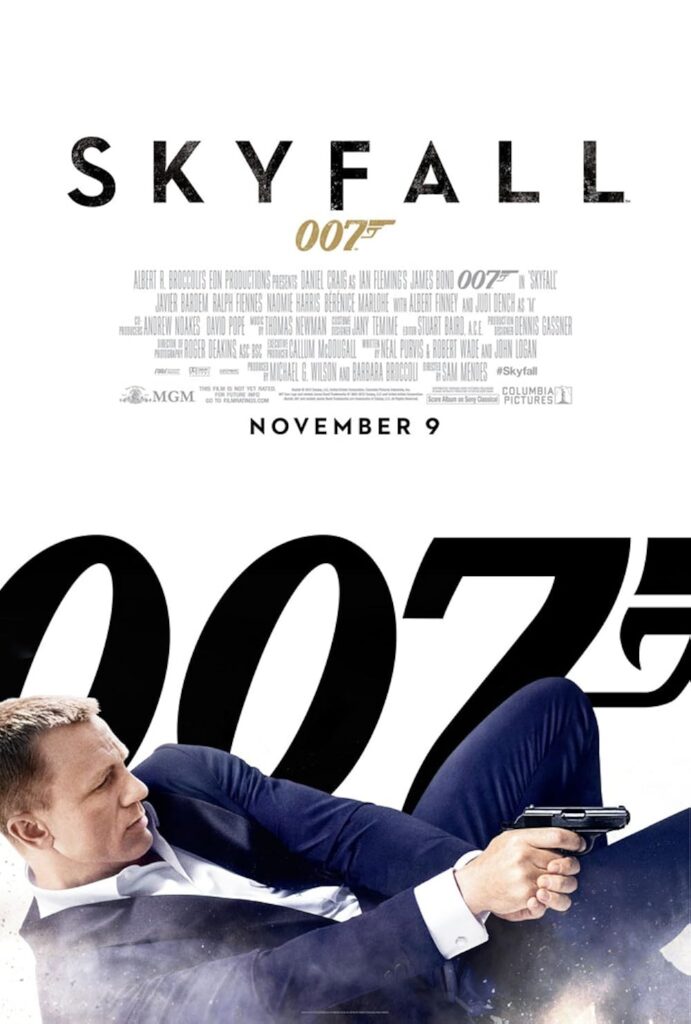
The story opens with a chaotic mission in Istanbul that ends in apparent failure when Bond is shot and presumed dead. This moment sets the thematic tone: Bond is wounded, physically and psychologically, and the world seems ready to move on without him. As MI6 comes under cyberattack and its agents’ identities are exposed, Bond resurfaces—damaged, out of practice, but driven by an unshakable sense of duty. The threat behind the attack leads to a deeply personal adversary, turning the conflict into something far more intimate than a battle for global dominance.
Daniel Craig delivers a richly layered performance, portraying Bond as an aging warrior struggling with doubt, pain, and relevance. This is not the invincible spy of earlier eras, but a man confronting his own limits. Craig allows Bond to fail, hesitate, and suffer—making his resilience all the more compelling. His journey in Skyfall is not about proving superiority, but about reaffirming purpose in a world that sees him as expendable.
Judi Dench’s M stands at the emotional core of the film. Her authority is tested publicly and privately as political oversight challenges MI6’s existence. The relationship between Bond and M—built over Craig’s previous films—comes to a head here, revealing a bond rooted in mutual trust, disappointment, and unspoken affection. Their dynamic elevates the story beyond action, turning it into a meditation on leadership and responsibility.
The villain, Raoul Silva, portrayed with unsettling brilliance by Javier Bardem, is one of the franchise’s most memorable antagonists. A former agent betrayed by the system he served, Silva embodies the consequences of institutional neglect and obsession. He is theatrical, cruel, and deeply wounded, using psychological warfare rather than brute force to dismantle MI6. Silva’s fixation on M transforms the film into a personal reckoning rather than a conventional spy-versus-villain narrative.
Visually, Skyfall is a landmark achievement. Cinematographer Roger Deakins crafts images of striking beauty—from neon-lit Shanghai skylines to the stark isolation of the Scottish Highlands. The film’s final act, set at Bond’s ancestral home, strips away gadgets and spectacle in favor of raw survival. This return to origins reinforces the film’s central theme: when everything else is stripped away, Bond is defined not by tools or status, but by resolve.
Thomas Newman’s score departs from tradition while honoring the franchise’s musical heritage, and Adele’s title song “Skyfall” echoes the film’s grandeur and melancholy. Together, the music and imagery give the film a timeless, almost mythic quality.
In its conclusion, Skyfall closes a chapter in Bond’s life. Loss is permanent, wounds do not fully heal, and the cost of loyalty is laid bare. Yet the film ends not in despair, but in renewal—reaffirming the enduring necessity of James Bond and the institution he serves, even as they evolve.
Today, Skyfall is often cited not only as one of the best Bond films, but as one of the finest modern action films overall. It balances introspection with spectacle, honoring the past while reshaping the future. By daring to slow down, look inward, and confront mortality, Skyfall proves that James Bond endures not because he never changes—but because he understands when he must.
Did You Know:
- Skyfall was released to celebrate the 50th anniversary of the James Bond film series, and it deliberately weaves themes of legacy and continuity into the story.
- Cinematographer Roger Deakins shot the film using digital cameras, making Skyfall the first Bond movie filmed entirely digitally—and one of the most visually praised.
- Adele’s theme song “Skyfall” became the first Bond theme to win an Academy Award, along with a Golden Globe.
- Javier Bardem’s villain, Raoul Silva, was inspired in part by classic Bond antagonists while also drawing on modern cyberterrorism fears.
- The film marks the final appearance of Judi Dench as M, ending a 17-year run that spanned four Bond actors.
- The Shanghai skyscraper fight scene was filmed on a soundstage with LED light panels, not on location, creating its striking neon silhouette look.
- Bond’s childhood home, “Skyfall,” was built as a temporary set in Scotland, designed to look weathered and isolated rather than grand.
- Daniel Craig performed many of his own stunts, including intense fight sequences, despite suffering multiple injuries during production.
- The film grossed over $1.1 billion worldwide, making it the highest-grossing Bond film at the time of release.
- Skyfall is often ranked among the top three Bond films ever made, praised for combining character depth, visual artistry, and franchise mythology.
Spectre (2015) — Daniel Craig
Spectre is a film driven by legacy, revelation, and an ambition to unify the modern James Bond saga into a single overarching narrative. Released in 2015, the movie follows the critical and commercial triumph of Skyfall and seeks to give Daniel Craig’s era a sense of mythic cohesion. Where Skyfall examined Bond’s loyalty and origins, Spectre turns inward, asking whether Bond’s greatest enemies have been external threats—or carefully orchestrated ghosts from his past.
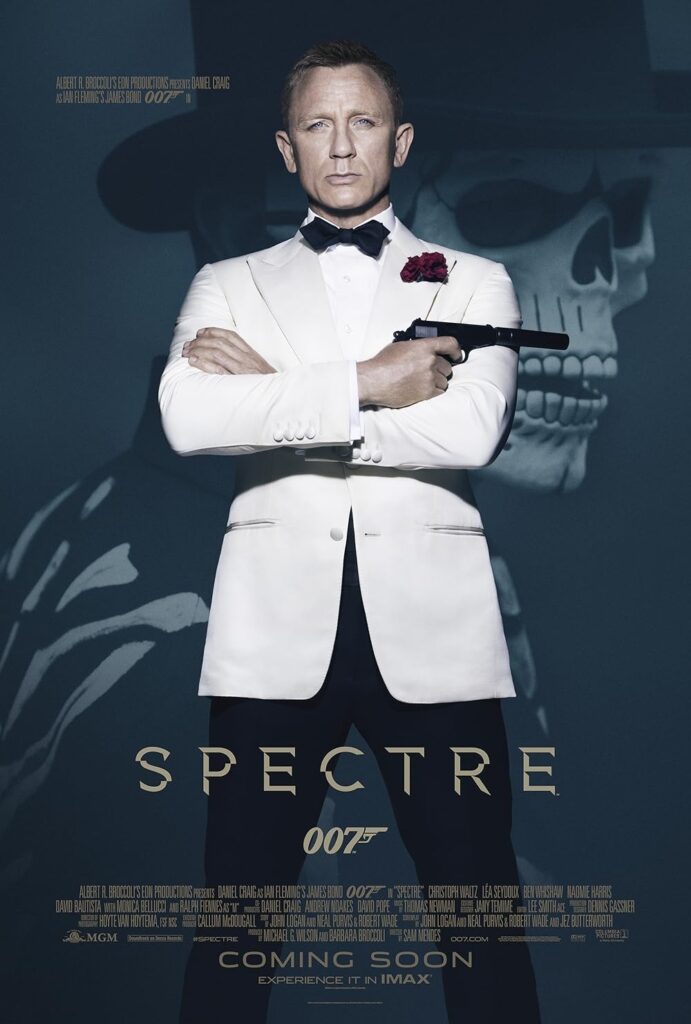
The story begins with a striking, visually immersive pre-title sequence set during the Day of the Dead festival in Mexico City. This opening immediately signals a return to classical Bond spectacle while grounding the action in mystery rather than chaos. Following an unauthorized mission inspired by a cryptic message from the late M, Bond uncovers the existence of a shadow organization manipulating global events from behind the scenes. As he follows the trail across Rome, Austria, and North Africa, Bond begins to realize that the threats he has faced in previous films may be interconnected pieces of a far larger design.
Daniel Craig’s Bond in Spectre is more controlled and introspective than ever before. Having endured physical and emotional devastation in earlier films, this Bond operates with quiet resolve rather than raw fury. Craig portrays a man who is no longer reacting to trauma, but actively seeking truth and closure. The film leans into Bond’s weariness, framing his journey as one of reckoning rather than survival.
The reintroduction of Ernst Stavro Blofeld—portrayed by Christoph Waltz—is the film’s most consequential narrative move. This modern incarnation of Blofeld is presented as the architect behind the suffering Bond has endured, a calculating presence who thrives on psychological dominance rather than spectacle. By tying Blofeld to Bond’s personal history, Spectre transforms the traditional supervillain into a deeply personal adversary. This decision reinforces the film’s core theme: the most dangerous control is the kind exercised over memory, identity, and emotion.
Léa Seydoux’s Madeleine Swann plays a pivotal role in the story, offering Bond something rare—emotional equilibrium. As the daughter of a former assassin connected to Spectre, Madeleine is burdened by her own inherited trauma. Her relationship with Bond develops slowly and deliberately, grounded in shared pain rather than flirtation. Unlike many earlier Bond romances, this connection is framed as a potential escape from the cycle of violence rather than a temporary distraction.
Visually, Spectre is polished and grand, embracing the franchise’s classic aesthetic. The Rome car chase, desert train fight, and alpine sequences recall Bond’s cinematic past while benefiting from modern filmmaking precision. Thomas Newman’s score returns, blending suspenseful motifs with echoes of classic Bond themes. Sam Smith’s title song, “Writing’s on the Wall,” underscores the film’s atmosphere of inevitability and emotional exposure.
The supporting cast further emphasizes continuity and evolution. Ralph Fiennes’ M navigates the political erosion of MI6, confronting surveillance culture and institutional overreach. Q and Moneypenny are given more active roles, reinforcing the idea that Bond is no longer a lone relic but part of a modernized team. These elements echo Skyfall’s exploration of relevance while extending it into a broader commentary on control and transparency.
In its final act, Spectre shifts from globe-spanning action to personal confrontation. Bond’s refusal to be defined by manipulation—choosing connection over isolation—marks a subtle but meaningful evolution of the character. The conclusion suggests the possibility of choice in a lifelong dictated by duty, setting the stage for the ultimate reckoning that would follow.
Today, Spectre is often viewed as an ambitious, if divisive, chapter in the Craig era. While opinions vary on its narrative choices, the film’s intent is clear: to bind Bond’s modern journey into a single, coherent mythos. As a meditation on fate, identity, and the cost of living in the shadows, Spectre stands as a reflective bridge between the introspection of Skyfall and the finality that awaited Bond’s story—reminding audiences that even legends must confront the architecture of their past.
Did You Know:
- Spectre marked the official return of the SPECTRE organization and Ernst Stavro Blofeld after decades of legal disputes over the rights to the name.
- Christoph Waltz’s casting fueled months of speculation before release, as producers initially refused to confirm he was playing Blofeld.
- The Day of the Dead opening sequence in Mexico City was so influential that it inspired the city to create a real annual parade, which had not previously existed.
- The film features one of the longest continuous opening shots in Bond history, lasting over four minutes.
- Daniel Craig suffered a serious knee injury during filming, requiring surgery and briefly halting production.
- The Rome car chase was intentionally designed to be quiet and restrained, contrasting with louder, more explosive Bond pursuits.
- The desert train fight was a throwback to classic Bond hand-to-hand combat, staged with minimal dialogue and heavy physicality.
- Sam Smith’s theme song “Writing’s on the Wall” became the first Bond theme to reach No. 1 on the UK charts.
- The film subtly retcons previous Craig-era villains as being connected to Spectre, creating a single overarching narrative.
- Despite mixed fan reception, Spectre was a major box-office success, cementing Craig’s era as one of the franchise’s most commercially successful.
No Time to Die (2021) — Daniel Craig
No Time to Die is a sweeping, emotionally definitive conclusion to Daniel Craig’s tenure as James Bond, bringing unprecedented finality to a character long defined by survival. Released in 2021 after multiple delays, the film arrives with the weight of legacy on its shoulders—not only closing a five-film arc but daring to ask what it truly costs to live a life in the shadows. Where earlier Craig-era films explored Bond’s origins, trauma, and reckoning, No Time to Die confronts consequence, love, and sacrifice with rare seriousness.
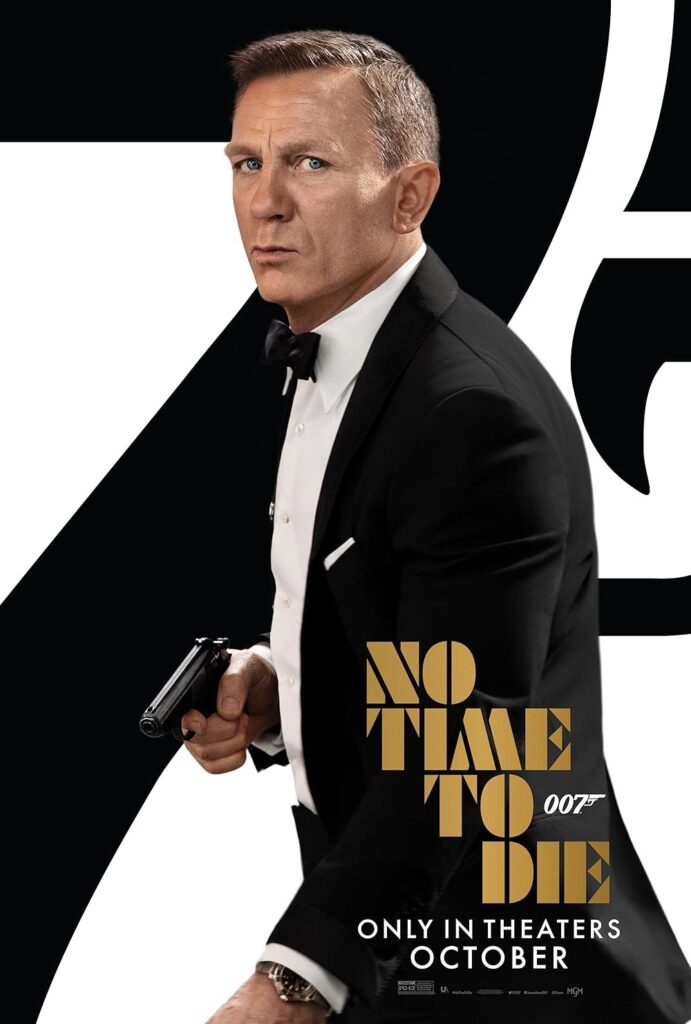
The story opens in Matera, Italy, where Bond is living in self-imposed retirement with Madeleine Swann. A sudden betrayal—real or perceived—shatters that peace, pushing Bond back into isolation and distrust. Years later, a new global threat emerges involving a missing scientist and a terrifying bioweapon capable of targeting individuals by DNA. Drawn back into the world of espionage, Bond must navigate fractured alliances, resurfacing ghosts, and a mission that is as personal as it is catastrophic.
Daniel Craig’s Bond is older, wearier, and more emotionally open than ever before. This is a man who has tried to step away from violence and found that the past does not loosen its grip so easily. Craig plays Bond with gravity and restraint, allowing moments of tenderness and regret to coexist with ferocity and resolve. The performance is less about proving strength and more about choosing purpose—what, and who, is worth fighting for when survival is no longer the sole objective.
Léa Seydoux’s Madeleine Swann is central to the film’s emotional spine. Their relationship, tested by secrets and time apart, evolves into something deeper and more vulnerable than any previous Bond romance. Madeleine is not merely a love interest; she is a mirror to Bond’s desire for a different life, and the stakes of their connection transform the mission into a question of legacy rather than victory.
The antagonist, Safin—portrayed with chilling quiet by Rami Malek—is a departure from bombast. His menace is intimate and unsettling, driven by obsession and a warped sense of balance rather than spectacle. Safin’s plan, centered on a programmable bioweapon, taps into modern anxieties about technology, control, and irreversible harm. He is less a conqueror than a corrupter, forcing Bond to confront threats that cannot be simply disarmed or outpunched.
Visually, No Time to Die is expansive and elegant. From the sun-soaked stone streets of Italy to the cold isolation of a fortified island, the film balances beauty with dread. Cary Joji Fukunaga’s direction emphasizes clarity and scale, while action set pieces—particularly the opening chase and the final assault—are staged with precision and emotional momentum. Hans Zimmer’s score weaves classic Bond motifs with somber, propulsive themes, and Billie Eilish’s title song underscores the film’s mood of inevitability and resolve.
The supporting cast reinforces the sense of culmination. Lashana Lynch’s Nomi introduces a new dynamic to the “00” designation, reflecting a changing world and a Bond who must share space rather than dominate it. Ralph Fiennes’ M, Ben Whishaw’s Q, and Naomie Harris’ Moneypenny bring continuity and warmth, grounding the story in relationships built over time. These interactions emphasize that Bond’s greatest strength may be connection rather than isolation.
In its final act, No Time to Die makes a choice unlike any previous Bond film. The resolution is bold, tragic, and purposeful—eschewing the traditional reset for a definitive end that honors the arc Craig’s Bond has traveled. It reframes heroism not as invulnerability, but as the willingness to bear the ultimate cost so others can live free from the consequences of your past.
Today, No Time to Die stands as a landmark in the franchise—a film that dared to close a chapter with honesty and heart. By allowing James Bond to love fully and choose selflessness over survival, it transforms a cinematic icon into a complete character. It is not just an ending, but a statement: legends endure not because they never fall, but because they decide, in the end, what truly matters.
Did You Know:
- No Time to Die is the first official James Bond film to give Bond a definitive ending, breaking a 60-year tradition of narrative reset.
- Daniel Craig personally advocated for Bond’s final fate, insisting the character needed a meaningful conclusion rather than another reboot-style exit.
- The film experienced multiple release delays, becoming the longest-delayed Bond movie in history, largely due to the COVID-19 pandemic.
- Rami Malek’s villain Safin was designed to be quiet, restrained, and unsettling, deliberately avoiding the flamboyance of classic Bond antagonists.
- Lashana Lynch’s character Nomi became the first woman to hold the 007 designation, reflecting a modernized MI6 rather than replacing Bond himself.
- Billie Eilish became the youngest artist ever to record a Bond theme song, and “No Time to Die” won the Academy Award for Best Original Song.
- Hans Zimmer incorporated subtle musical callbacks to earlier Craig-era films, including Casino Royale and Skyfall, to reinforce the sense of finality.
- The opening sequence in Matera, Italy, is considered one of the most visually stunning pre-title sequences in the franchise’s history.
- This was the only Bond film directed by Cary Joji Fukunaga, who focused heavily on emotional continuity rather than episodic adventure.
- No Time to Die officially closed the Daniel Craig Bond era as a complete five-film arc, something no previous Bond actor had been given.
BONUS
Never Say Never Again (1983) – Sean Connery
Never Say Never Again occupies a unique and often misunderstood place in James Bond history. Released in 1983, the film is not part of the official EON Productions Bond canon, yet it stars the most iconic Bond actor of all—Sean Connery—returning to the role for the final time. Functioning as an independent remake of Thunderball, the film exists in a parallel Bond universe, offering a fascinating “what-if” version of 007 shaped by age, experience, and a markedly different creative vision.
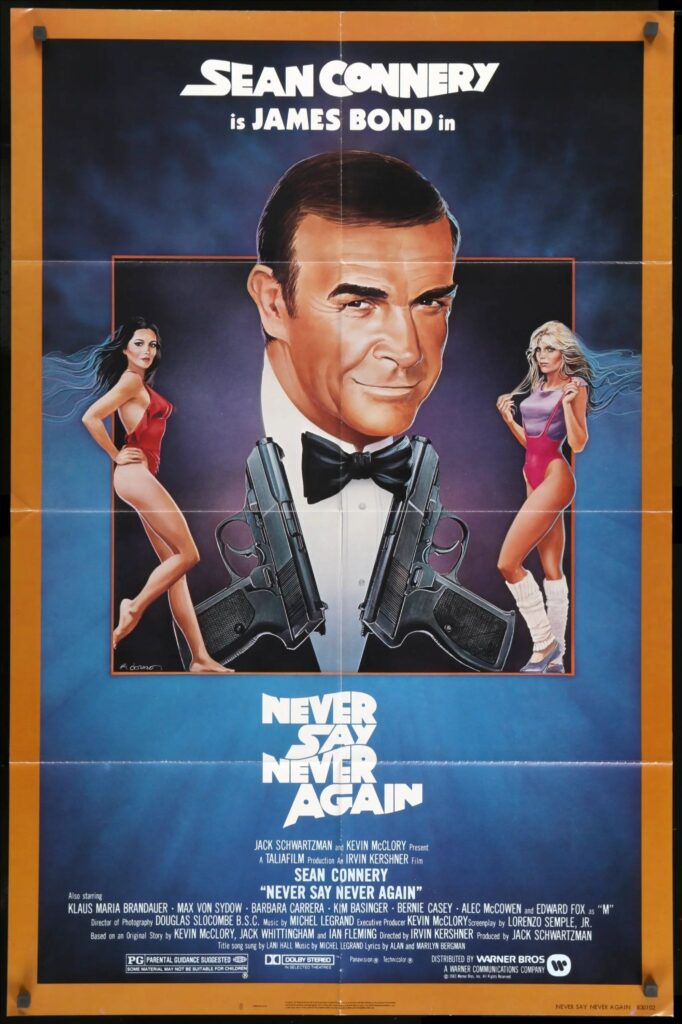
The story follows James Bond as he is reluctantly pulled out of semi-retirement to stop a familiar threat: the theft of nuclear warheads by a criminal organization seeking global leverage. The plot closely mirrors Thunderball, but with updates reflecting the early 1980s world of advanced technology, shifting geopolitics, and modern espionage. Bond’s mission takes him from Europe to the Caribbean, where he confronts a charismatic and dangerously unpredictable adversary determined to challenge not just governments, but Bond himself.
Sean Connery’s performance is the heart of the film. Older, heavier, and visibly wearier than his 1960s incarnation, Connery plays Bond as a seasoned veteran—still sharp, still dangerous, but no longer invincible. This Bond relies less on brute force and more on intelligence, manipulation, and psychological insight. Rather than pretending time hasn’t passed, the film embraces Bond’s age, making experience his greatest weapon. The title itself—Never Say Never Again—is a winking acknowledgment of Connery’s long-declared departure from the role.
The villain, Maximilian Largo, portrayed by Klaus Maria Brandauer, is one of the film’s strongest elements. This version of Largo is more volatile, emotional, and theatrical than his 1965 counterpart. Brandauer plays him as a man driven by ego and obsession rather than detached calculation, creating a dynamic where Bond and villain engage in verbal and psychological sparring as much as physical confrontation. Their relationship feels more personal and confrontational, emphasizing rivalry over spectacle.
Kim Basinger’s Domino Petachi brings a modernized sensibility to the Bond woman archetype. While still caught in the orbit of a powerful villain, Domino is portrayed with greater independence and emotional agency than earlier versions of the character. Her gradual alignment with Bond feels rooted in self-preservation and awakening rather than instant romance, reflecting the film’s more grounded, character-focused approach.
Stylistically, Never Say Never Again differs noticeably from official Bond films. It lacks the traditional gun-barrel opening, the iconic James Bond Theme, and the polished EON aesthetic. Instead, the film adopts a slightly grittier, more contemporary look, with a musical score that leans into early-1980s sensibilities. Action sequences are less flamboyant, favoring realism and tension over extravagant set pieces, reinforcing the idea that this is a Bond who wins through strategy rather than spectacle.
The film’s tone is reflective and self-aware. Humor is present, but it often carries an edge of irony, acknowledging Bond’s mortality and the changing nature of espionage. Scenes involving advanced training methods and younger agents subtly frame Bond as a man out of step with modern systems—yet still indispensable when experience matters most.
Upon release, Never Say Never Again was inevitably compared to Octopussy, the official Bond entry released the same year. While Octopussy won the box-office battle, Never Say Never Again carved out its own legacy as a thoughtful, alternative take on Bond—one less concerned with continuity and more interested in character.
Today, Never Say Never Again is best appreciated as a cinematic curiosity and a dignified farewell. It offers a rare glimpse of an aging Bond allowed to evolve naturally, rather than remain frozen in myth. Though it stands outside official canon, the film remains an essential footnote in Bond history—a reminder that James Bond is not just a symbol, but a role that can reflect time, change, and the weight of experience.
In the end, Never Say Never Again is not about reinventing Bond or escalating spectacle. It is about closure—about allowing the original Bond to walk away on his own terms, proving that even legends sometimes get one last mission, and one last word.
Did You Know:
- Never Say Never Again is not part of the official EON Productions Bond canon, due to long-running legal disputes over the rights to Thunderball.
- The film is essentially a remake of Thunderball (1965), produced by Kevin McClory, who retained adaptation rights to that story.
- Sean Connery returned to the role at age 52, making him the oldest actor ever to play James Bond in a feature film.
- The title comes from Connery’s wife, who reportedly told him “Never say never again” after he repeatedly claimed he would never play Bond again.
- Unlike official Bond films, the movie does not feature the gun-barrel sequence or the classic James Bond Theme due to rights restrictions.
- Klaus Maria Brandauer’s Largo is portrayed as far more emotional and unstable than the cool, calculating version seen in Thunderball.
- The film was released in direct competition with Octopussy, leading to the rare “Bond vs Bond” box-office showdown of 1983.
- Kim Basinger was still early in her career; this film helped elevate her to major Hollywood stardom.
- The soundtrack leans heavily into 1980s electronic and jazz elements, making it stylistically distinct from John Barry–scored Bond films.
- Despite being unofficial, the movie was a commercial success and remains a fascinating “parallel universe” Bond story.
Conclusion
The James Bond canon stands as one of cinema’s greatest long-running achievements—a rare franchise that has not merely survived changing decades, but evolved with them. From its beginnings in the early 1960s through the modern, emotionally grounded era, Bond has continuously reflected the fears, fantasies, and values of the world around it. At its core, the canon tells the story of James Bond as both a symbol and a man: an elite intelligence officer navigating danger, loyalty, power, and identity across generations.
The early Bond films established the foundation of the myth. These stories introduced a confident, ruthless professional operating in a Cold War world defined by espionage and nuclear tension. The canon quickly learned how to balance realism with escapism—pairing grounded spycraft with exotic locations, memorable villains, and cinematic spectacle. Bond became not just a character, but a cultural constant: recognizable, aspirational, and endlessly adaptable.
As the series matured, the canon proved willing to experiment. Humor, excess, and spectacle expanded the franchise’s reach during eras of global fatigue and cultural change, while later entries pulled Bond back toward realism and consequence. Importantly, the canon never fully discarded its past. Instead, each era layered new meaning onto what came before—sometimes embracing fantasy, sometimes rejecting it, but always responding to the moment in which the films were made.
The modern phase of the Bond canon transformed the series from episodic adventures into an interconnected character arc. Bond was allowed to age, fail, love, grieve, and ultimately confront the cost of his life’s work. This evolution elevated the canon beyond formula, giving emotional continuity and thematic weight to a character once defined solely by invincibility. In doing so, the series demonstrated that even icons can grow without losing their essence.
From a Nerd-Central perspective, the Bond canon earns admiration precisely because it changes without breaking. The series respects its legacy while refusing stagnation. It understands that relevance is not achieved by repeating the past, but by reinterpreting it. Whether leaning into classic espionage, high adventure, or psychological depth, Bond remains compelling because the canon treats reinvention as a strength, not a betrayal.
Nerd-Central genuinely likes the Bond series because it represents long-form storytelling done right across decades. Few franchises can claim such cultural endurance, fewer still can claim meaningful evolution. James Bond endures not because he is timeless, but because he reflects time itself—adapting to new threats, new values, and new definitions of heroism, while still delivering the thrill, style, and intrigue that made 007 legendary in the first place.